



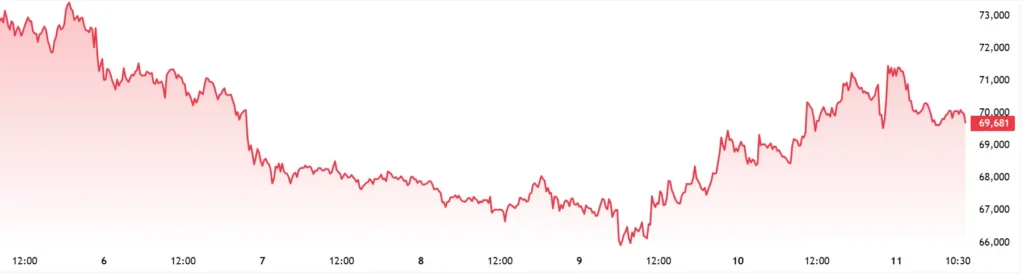
Bitcoin surged back above $70,000 on Wednesday, fueled by renewed risk appetite after US President Donald Trump indicated the US-Israeli war with Iran could conclude soon. The cryptocurrency climbed 1.4% to $70,007, recovering from a dip toward $68,400 amid earlier tensions in the Middle East.
Market Snapshot
Bitcoin (BTC) traded at $70,007, up 1.4% in the last 24 hours after touching a low of $68,421. Ethereum (ETH) gained 3% to around $2,085, while XRP jumped 5.3% to $1.43 and Solana (SOL) rose 3.5%.
US equities steadied, with the S&P 500 (SPX) at 6,781, down 0.2% but off session lows following Wall Street gains. Brent crude (LCOc1) eased to near $68 per barrel, retreating from Monday’s spike toward $120 on supply disruption fears.
The 10-year US Treasury yield held at 4.12%, reflecting cautious flows into safe havens amid lingering inflation worries from oil volatility.
Trump Remarks Spark Rally
President Trump stated the conflict could resolve soon, though not this week, calming markets rattled by escalation risks. He warned Iran against closing the Strait of Hormuz, vowing a response “20 times harder” to protect vital oil routes.
Trump’s comments followed a brief Bitcoin plunge to $65,000 earlier in the week, as surging oil prices ignited global inflation fears and prompted risk-off moves. Asian stocks rebounded, tracking Wall Street’s overnight lift.
“This de-escalation signal from the White House flipped sentiment overnight,” said a New York-based crypto trader at Galaxy Digital.
Broader Asset Reactions
Oil’s pullback from $120 eased pressure on equities, with Nasdaq futures up 0.01% after recent tech-led losses. Gold held steady as a hedge, while the dollar index (DXY) dipped slightly on risk-on flows.
Altcoins mirrored Bitcoin’s recovery in range-bound trade, with Dogecoin surging over 8%. Meme tokens and DeFi assets led gains, signaling retail return amid improved geopolitics.
Yields stabilized as bond investors weighed oil’s retreat against persistent inflation data ahead. Regional benchmarks in Asia clawed back Monday’s sharp selloff.
Inflation and Macro Pressures
Trump’s outlook tempered fears of prolonged oil spikes fueling higher CPI, after January’s 2.4% year-on-year rise, down from 2.7% but with upside risks noted. Energy costs fell 1.5% that month, but fresh Middle East shocks had threatened a reversal.
A sustained Iran conflict could add 20-30 bps to US inflation via $10+ oil jumps, complicating Fed rate cuts amid 4.1% yields. Growth forecasts face headwinds if energy passes through to consumers.
“Markets priced in worst-case Hormuz closure; Trump’s tone reduces that tail risk,” noted TD Economics analyst in a research note.
Policy Response Signals
The White House emphasized preemptive strikes curbed Iran’s nuclear push, aligning with Trump’s prior criticism of past deals. US forces monitor Strait flows, key for 20% of global oil.
Fed officials eye incoming data before March moves, with oil volatility testing soft-landing bets. Traders price 60% odds of a 25-bps cut next month.
Key Trader Monitors
Traders watch Thursday’s February PCE inflation gauge, the Fed’s preferred metric, for clues on oil pass-through. Escalation signals from Iran or Strait disruptions top risks, alongside any Trump policy updates on crypto regulations.
Fresh US CPI previews and Asian energy demand data will gauge sustained risk appetite. Bitcoin support at $68,000 remains critical if tensions reignite.