


SpaceX shares extended gains in early trading after a blockbuster market debut that valued the company at roughly $2.1 trillion, driven by sustained post-IPO momentum and heavy demand from institutional and retail investors. The stock continued to trade higher following a 19% surge on its Nasdaq listing day.
Market snapshot
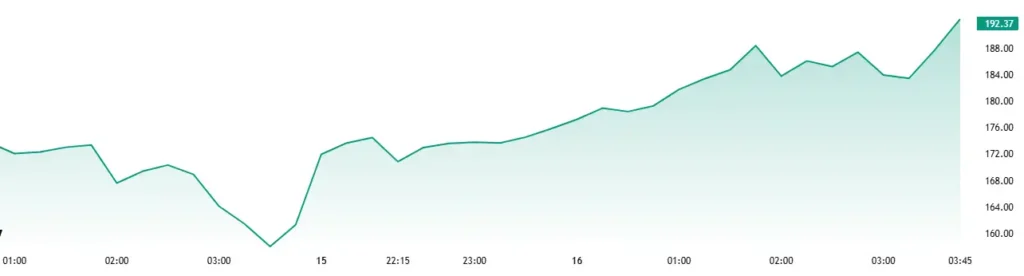
SpaceX (SPCX) rose further in premarket and early sessions after closing its first full trading day near $160–$192 levels, pushing its market capitalisation above $2 trillion. The IPO, priced at $135 per share, raised around $75 billion in what is now the largest listing in market history.
More than 500 million shares changed hands on debut, with early follow-through adding another 5–7% in premarket trading, reflecting strong liquidity and continued demand.
Event details
The IPO’s scale and pricing reset expectations across mega-cap equities, with SpaceX instantly ranking among the largest companies globally. The company’s valuation has been driven by investor optimism around its satellite internet business, launch dominance, and long-term space infrastructure ambitions.
“Elon Musk said the listing marks the start of a significant growth phase,” according to remarks on a pre-IPO livestream, highlighting expectations of expanding satellite deployments and space-based computing initiatives.
Analysts note that despite the enthusiasm, SpaceX remains unprofitable, with 2025 revenue estimated at roughly $18.7 billion and continued heavy investment in Starship development and AI-related infrastructure.
Risk-on flows and index mechanics
The debut triggered broad risk-on positioning, with traders pointing to strong retail participation alongside institutional allocations as a key driver of momentum.
“Demand has been unusually deep for a name of this size, and the float dynamics are amplifying price discovery,” one equity strategist said, adding that early trading resembled a “liquidity chase rather than fundamentals-led re-rating.”
Jefferies and other brokers also highlighted potential future index inclusion flows, which could force passive funds and ETFs to accumulate shares over time—adding mechanical support to demand in coming months.
Cross-asset impact
The rally in SpaceX coincided with strength in broader growth equities, while defensive assets came under mild pressure. Treasury yields edged higher as investors rotated into risk assets, reflecting improved sentiment toward high-duration tech and infrastructure plays.
Safe-haven demand softened, with traders reporting weaker interest in traditional hedges as equity volatility remained contained following the IPO event. Currency markets showed limited reaction, though risk-sensitive FX pairs tracked the broader equity tone.
Valuation debate and macro implications
At a valuation above $2 trillion, SpaceX now sits in the same league as the world’s largest technology firms, prompting debate over sustainability. Some analysts warn that its price implies aggressive long-term growth assumptions across satellite broadband, launch services, and emerging space-based computing.
“Markets are effectively pricing SpaceX as a multi-industry platform rather than a single aerospace company,” said one fund manager, noting that execution risk increases sharply at this scale.
Broader macro implications include heightened sensitivity to interest rates and liquidity conditions, given the stock’s long-duration growth profile. Any shift in rate expectations could amplify volatility in mega-cap tech.
Outlook risks
Traders are now watching whether early post-IPO momentum can hold as lock-up structures, index rebalancing timelines, and earnings visibility come into focus. Volatility is expected to remain elevated as price discovery continues in a limited-float environment.