


West Texas Intermediate (WTI) crude futures pulled back after pushing above $100 a barrel as diplomatic efforts gained traction to reopen the Strait of Hormuz, easing some supply-disruption fears. Brent crude (LCOc1) followed suit, trimming earlier gains amid signs of coordinated efforts by allies to restore flows through the vital chokepoint.
Market Snapshot
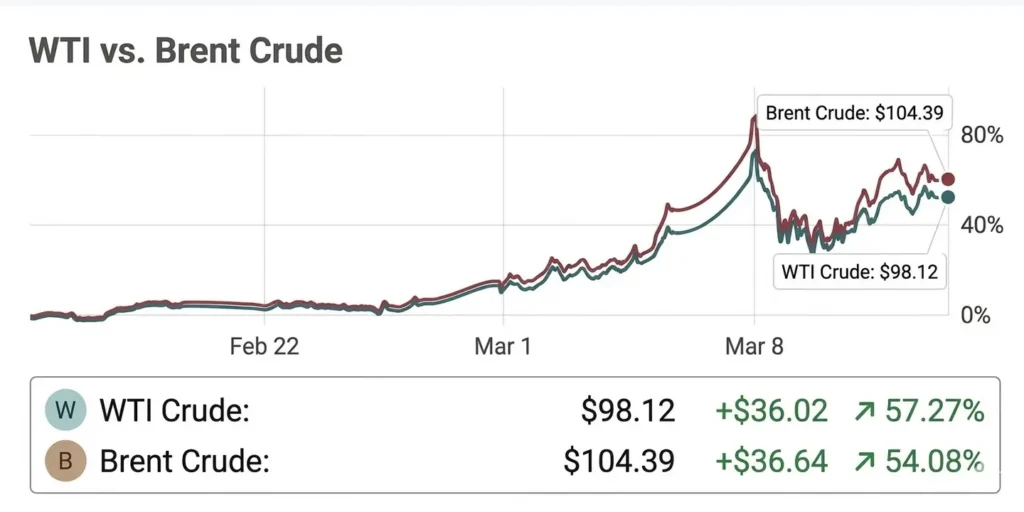
WTI crude (CLc1) settled at $98.50 per barrel, down 1.2% from Monday’s intraday peak of $101.20, after rallying over 9% the prior session on Iran’s threats to block the strait. Brent eased 0.8% to $102.30, paring a three-week surge that doubled prices from January lows near $60. US gasoline futures (RBc1) climbed 0.3% to $3.25 per gallon, reflecting tight refined product balances.
Geopolitical Trigger
Tensions escalated after US-Israeli strikes on Iran sparked the conflict on February 28, prompting Iran to functionally close the Strait of Hormuz, through which 20% of global oil flows. Iran’s Revolutionary Guard warned no oil would pass, while Supreme Leader Mojtaba Khamenei vowed a sustained blockade amid attacks on Gulf shipping. Production halts in Iraq and Kuwait compounded fears, wiping millions of barrels from the daily supply.
Reopening Momentum
President Donald Trump urged allies, including the UK to escort ships and deploy mine-hunting drones to clear the strait, prompting London to weigh options. UK Energy Secretary Ed Miliband called reopening a priority, while Iran’s IRGC commander insisted the route stays under Tehran’s control but did not rule out flows. Markets reacted to these signals, stalling the rally despite Goldman Sachs’ warning of $150 peaks if closure drags into late March.
Policy Responses
The International Energy Agency coordinated 400 million barrel releases from strategic reserves, including 172 million from the US, to cap price spikes. OPEC+ signaled readiness to adjust output, though Gulf curtailments limit flexibility. The US Treasury issued licenses for the purchase of stranded Russian oil to bolster global oil stocks.
Broader Asset Flows
Equities retreated with the S&P 500 (SPX) down 0.5% as energy costs threatened growth; the energy sector (XLE) bucked the trend, up 2%. Safe-haven gold (GCc1) rose 1% to $2,850 an ounce, while the dollar index (DXY) gained 0.3% versus the euro. US 10-year Treasury yields fell 5 basis points to 4.05%, signaling risk-off bets on inflation pass-through.
“Reopening talks are a relief valve, but one drone strike changes everything, we’re not out of the woods,” said Ole Hansen, head of commodity strategy at Saxo Bank. JPMorgan analysts noted that a 3-4-week blockade could force GCC shut-ins and lift Brent above $100 sustainably.
Macro Implications
Surging oil prices risk adding 2-3% to global inflation, complicating Federal Reserve rate cuts amid sticky prices. Growth forecasts are likely to be downgraded if disruptions persist, with Europe most exposed due to higher energy imports. Central banks monitor pass-through to consumer spending and policy paths.
Traders watch escalation signals from Iran, IEA reserve draw efficacy, and next week’s US inventory data for cues on demand resilience.