


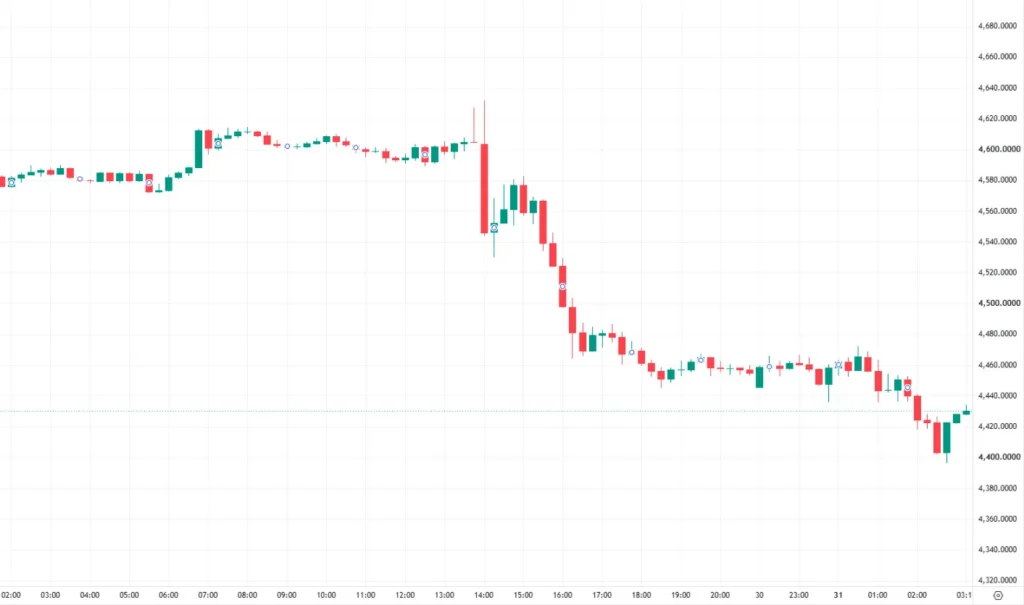
Gold prices fell sharply on Friday after Federal Reserve Chair Kevin Warsh struck a hawkish tone in his Jackson Hole speech, reviving expectations for a September rate hike. Spot gold dropped more than 3% as the dollar strengthened and Treasury yields climbed.
Gold Price Drop and Market Data
At 16:00 ET (20:00 GMT), spot gold (XAU/USD) was down 3.2% at $4,456.20 per ounce, while gold futures (GC) fell 3.4% to $4,506.66. For the week, spot gold was set to close 3.2% lower and futures down 3.8%, marking a reversal from the previous week’s rally.
The US dollar index rose nearly 1%, adding pressure on the non-yielding metal. Silver, platinum and other precious metals also traded lower in sympathy with gold’s move.
Warsh Jackson Hole Speech Highlights
Warsh delivered his first keynote address as Fed Chair at the annual Jackson Hole Economic Policy Symposium in Wyoming. He said underlying inflation trends had not “meaningfully improved” and reaffirmed the central bank’s commitment to price stability.
“As of now, I believe the labor markets are consistent with full employment. But on the price-stability side of our mandate, the numbers are more concerning,” Warsh said in prepared remarks.
His comments came amid a complicated backdrop for the Fed. Sticky inflation readings, elevated oil prices linked to ongoing geopolitical tensions, and a softer-than-expected nonfarm payrolls report have divided the Federal Open Market Committee. Three regional Fed presidents dissented from July’s decision to hold rates steady.
Gold Trading Reaction to Fed Rate Hike Expectations
Traders quickly adjusted their expectations for monetary policy following the speech. According to the CME FedWatch tool, the probability of a 25 basis point rate hike in September rose to more than 57%, up from about 35% the day before.
US Treasury yields moved higher as bonds were sold off. The benchmark 10-year yield climbed 5.3 basis points to 4.725%, while the 2-year yield jumped 12 basis points to 4.352%. The bond market has been volatile in recent weeks, driven by inflation concerns, heavy corporate debt issuance and worries over the US national debt, which recently surpassed $40 trillion.
“Chair Warsh reiterated the Federal Reserve’s inflation focus during his inaugural Jackson Hole symposium presentation this morning, resulting in a hawkish reprice across the yield curve,” said José Torres, senior economist at Interactive Brokers.
“Still, the monetary policy leader was relatively quiet about the timing of the committee’s next move, and his success in striking a delicate balance between prioritizing cost forces and avoiding a direct commitment to a rate increase sparked rallies in stocks, the greenback and duration,” Torres added.
Gold Price Outlook and Fed Policy Context
Gold had rallied the previous week on what traders dubbed the “debasement trade”, as investors moved capital out of fiat currencies and into hard assets amid fiscal skepticism. The surge in long-end Treasury yields and news that US debt had crossed $40 trillion fueled demand for inflation hedges such as gold and cryptocurrencies.
However, the relationship between bond yields and gold is nuanced. While rising yields typically make non-yielding assets less attractive, last week’s bond sell-off coincided with gold’s advance as investors sought protection against potential currency debasement.
Warsh’s speech appeared to temper some of those fears, at least in the near term, by signalling that the Fed remains focused on controlling inflation rather than accommodating fiscal expansion.
What to Watch Next for Gold Investors
Market participants will now watch several key factors in the coming days. First, upcoming US economic data, including personal consumption expenditures and employment figures, could influence the Fed’s September decision. Second, geopolitical developments, particularly around oil markets and US–Iran tensions, may affect inflation expectations and safe-haven flows. Finally, traders will monitor Treasury market dynamics and any further commentary from Fed officials for clues on the timing and magnitude of the next policy move.
For gold, the direction of the dollar and real yields will remain critical. A sustained hawkish shift from the Fed could cap bullion’s upside, while renewed fiscal or geopolitical risks may reignite demand for the metal as a hedge.