


Bitcoin climbed back above $80,000 on Thursday as a powerful rally in US technology shares boosted risk appetite, while investors continued to assess Washington’s evolving cryptocurrency rules and tensions in the Middle East. The world’s largest cryptocurrency rose 1.9% to about $80,245 by 2256 GMT.
Market Snapshot
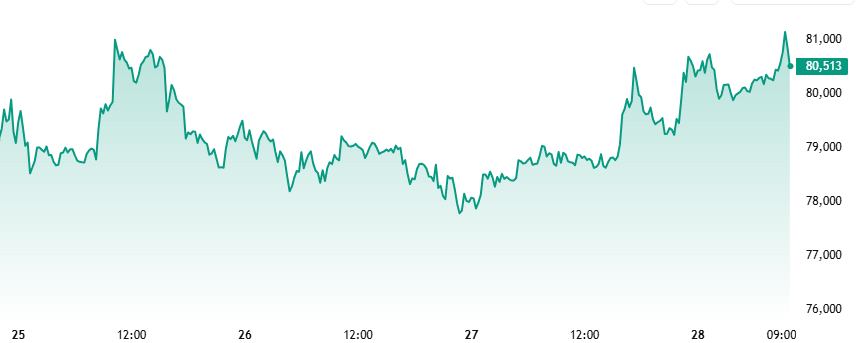
Bitcoin (BTC/USD) recovered from an earlier decline that took it to around $78,676 during Asian and European trading. It briefly moved above $80,000 later in the US session, although it remained below the roughly $82,000 peak reached earlier in the week.
The cryptocurrency has gained more than 25% in August after trading below $60,000 earlier in the northern summer. The rebound has been supported by institutional inflows, short-covering and renewed demand for assets viewed as alternatives to the US dollar.
Ether rose about 0.8% to $2,514, while XRP gained more than 3%. Solana outperformed the broader market with a gain of more than 7%.
Nvidia Rally Boosts Risk Appetite
Thursday’s Bitcoin advance accelerated alongside US technology shares after Nvidia (NVDA) delivered stronger-than-expected earnings and an upbeat long-term revenue forecast.
Nvidia shares jumped 8.7%, helping the Nasdaq Composite rise 1.6% and the S&P 500 gain 0.7%. The chipmaker forecast roughly 70% revenue growth for the fiscal year ending in January 2028, reinforcing confidence that investment in artificial intelligence infrastructure remains strong.
The improvement in equity sentiment spilled into cryptocurrencies, which often trade as high-volatility risk assets during periods of strong demand for technology and growth investments.
Bitcoin’s reaction also showed that the cryptocurrency remains influenced by traditional financial markets despite growing investor interest in its role as an alternative store of value.
Regulation Remains in Focus
US cryptocurrency policy remains another major driver.
President Donald Trump last week urged Congress to pass a version of the Clarity Act, legislation intended to establish a clearer regulatory framework for digital assets and define the respective responsibilities of the Securities and Exchange Commission and Commodity Futures Trading Commission.
The legislation has passed the House but remains stalled in the Senate amid disagreements over regulatory authority, stablecoin products and industry safeguards.
The SEC and CFTC have meanwhile moved to provide greater clarity through existing regulatory powers. The agencies are considering rules covering areas including digital-asset trading, custody and crypto derivatives.
Industry executives have welcomed regulatory progress but continue to argue that legislation is needed because agency rules can be changed by future administrations.
Debasement Trade Supports Bitcoin
Bitcoin’s August rally began accelerating after the US Treasury expanded buybacks of longer-dated government debt, a move designed to improve liquidity after Treasury yields rose sharply.
The intervention initially pushed yields lower and weakened the dollar, encouraging investors to increase exposure to scarce assets including Bitcoin and gold.
Bitwise Chief Investment Officer Matt Hougan described the combination of government bond-market intervention and geopolitical financial pressure as a “powerful setup” for Bitcoin.
Demand through regulated investment products has also strengthened. US spot Bitcoin exchange-traded funds have attracted billions of dollars in fresh capital over recent sessions, providing a more institutional foundation for the rally than during some previous crypto-market surges.
Iran Talks Keep Geopolitical Risks Elevated
Investors are also monitoring efforts to reduce tensions between the United States and Iran.
Iran and Oman have discussed arrangements for commercial shipping through the Strait of Hormuz, while Qatar has continued mediation aimed at establishing a broader diplomatic framework. The waterway remains critical to global energy supplies after months of disruption to tanker traffic.
Progress towards reopening Hormuz could reduce oil and inflation pressures. However, negotiations remain uncertain, and renewed military action could quickly lift energy prices and strengthen demand for traditional safe-haven assets.
For Bitcoin, the conflict has produced mixed effects. Geopolitical uncertainty can increase interest in assets outside the traditional financial system, but higher oil prices can also lift inflation and interest-rate expectations, reducing appetite for speculative investments.
Fed Outlook Caps Momentum
US monetary policy remains an immediate constraint on further gains. July Personal Consumption Expenditures inflation stood at 3.7% annually, while core inflation was 3.3%, leaving both measures above the Federal Reserve’s 2% objective.
Investors are now awaiting Fed Chair Kevin Warsh’s speech at the Jackson Hole symposium for clues about the September policy meeting.
Outlook
Bitcoin traders will watch whether the cryptocurrency can establish support above $80,000 and challenge this week’s peak near $82,000.
Warsh’s Jackson Hole comments, progress on the Clarity Act and further US regulatory announcements will provide the next major catalysts. Developments around the Strait of Hormuz and movements in Treasury yields and the dollar will also remain important for the broader cryptocurrency rally.