



The EURJPY exchange rate has shown some near-term weakness ahead of European data on Wednesday.
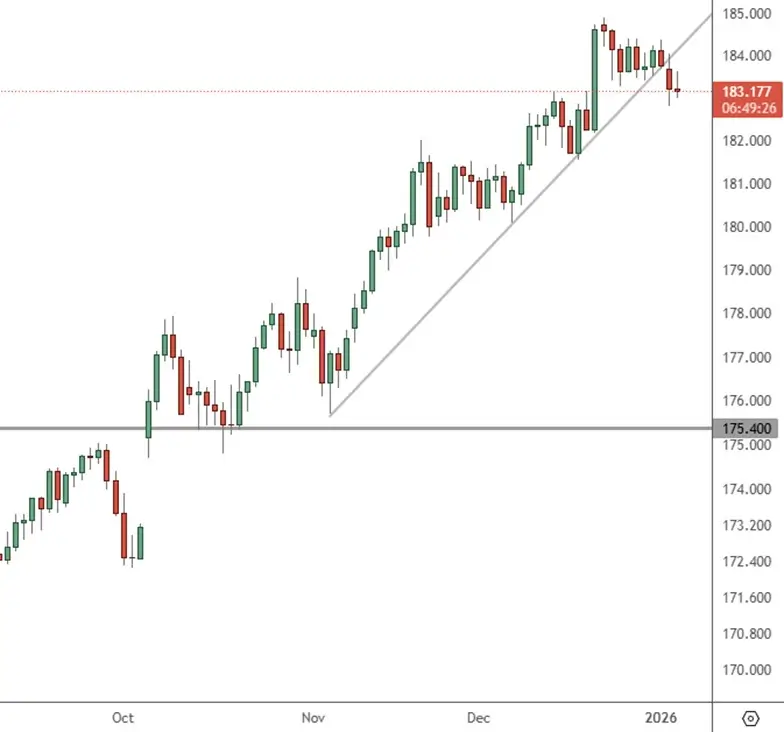
EURJPY – Daily Chart
The EUR/JPY has vaulted higher after breaking out above the July 2024 high. The price has recently shown weakness at the uptrend line, with potential for a pullback and a buying opportunity. Support is clustered ahead of the 180.00 price level.
German retail sales are due for release on Wednesday at 2pm HKT, with markets expecting a 0.2% increase after a -0.3% dip last month. The annual growth rate last month was 0.9%.
Investors will also get a look at European consumer prices at 5 pm HKT, which are expected to remain flat at 2.4%. German consumers may show some strength after inflation eased to 1.8% year-on-year in December, down from 2.3% in November.
Economists expect the inflation picture to remain above the 2% threshold in 2026, after Europe’s largest economy struggled to recover from years of high inflation. With energy costs soaring at the onset of the Russia-Ukraine conflict, Germany saw inflation reach 6.9% in 2022 and remain at 5.9% in 2023.
That has now stabilised, and the Ifo Institute in Munich projects inflation will remain at 2.2% in 2026, before rising to 2.3% in 2027. However, that is still close to the European Central Bank’s 2% target and keeps its monetary policy plans in place. Any weakness in retail sales or consumer prices could change the outlook.
The Japanese yen has been tumbling against global currencies into 2026, due to fears over the country’s debt load and bond market. Another headwind is a weakening of GDP expectations stemming from currency depreciation and concerns about tourism.
Japan’s economy is likely to fall behind India in 2026 to fifth place, according to an International Monetary Fund estimate. These trends are threatening the yen’s previous status as a safe-haven currency.
The economic outlook will now hinge on the Prime Minister’s planned growth strategy announced in the summer. Economists want to see productivity improvements and further efforts to access promising growth markets to combat a slowing population.
Japan’s economy shrank for the first time in six quarters during July-September, due to weaker exports from the U.S. tariffs, alongside issues such as currency. China’s call for tourists to avoid Japan could also have an adverse impact. On a positive front, corporate profits are expected to remain strong in 2026.