


Key Monitors
Traders will watch for:
- Hormuz traffic data: Confirmation that tankers are transiting the strait without incident over the next 48 hours.
- Lebanon front: Any escalation between Israel and Hezbollah that could prompt Iran to withdraw from the truce.
- Friday’s Islamabad talks: Direct US-Iran negotiations scheduled to begin, which could extend or collapse the two-week window.
US equity index futures held steady in early Asian trade on Thursday after Wall Street notched its biggest single-day gains in a year, driven by relief that a two-week ceasefire between the United States and Iran could ease tensions threatening global oil flows. The S&P 500 (SPX) jumped 2.5% to 6,782.96, while the Dow Jones Industrial Average (DJI) surged 2.9% to 47,909.92, and the Nasdaq Composite (IXIC) advanced 2.8% to 22,635.00.
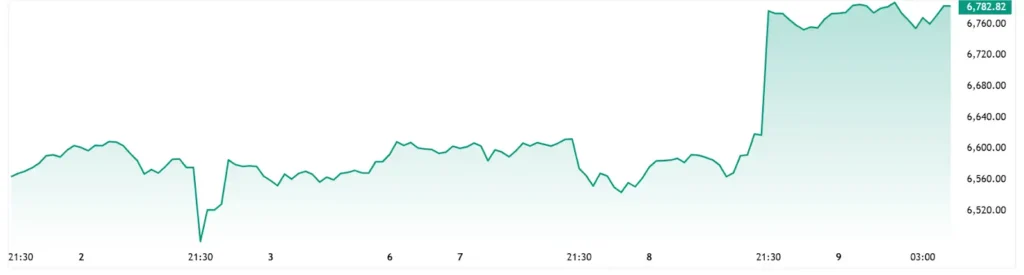
S&P 500 – 5 Days Chart
Market Snapshot
E-mini S&P 500 futures traded little changed near 6,816.0 points by 19:20 ET, while Nasdaq 100 futures slipped 0.15% to 25,036.25 and Dow futures edged down 0.1% to 48,112.0. The pause in momentum follows Wednesday’s broad-based rally, which saw all three major benchmarks erase most of March’s losses as traders priced in reduced geopolitical risk premiums.
Ceasefire Terms and Conditions
President Donald Trump announced late Tuesday that he had agreed to suspend bombing campaigns against Iranian infrastructure for two weeks, citing a “workable” 10-point proposal from Tehran that includes commitments to reopen the Strait of Hormuz for maritime traffic. Iran’s Supreme National Security Council confirmed acceptance of the truce, stating safe passage through the strategic waterway would be “possible” for the two-week period pending coordination with Iranian Armed Forces.
The deal averts Trump’s self-imposed deadline to unleash what he had threatened would be strikes capable of destroying Iran’s “whole civilization,” though terms remain contested. Tehran insists the ceasefire covers all fronts, including Hezbollah operations in Lebanon, while Jerusalem says its campaign against the militant group continues unabated.
Energy Markets React
Crude oil prices cratered on the news, with Brent futures plunging 14% to just under $94 per barrel and West Texas Intermediate falling nearly 15% to about $96. The sharp decline reflects market expectations that Hormuz reopenings could restore up to 17 million barrels per day of tanker flows that have been disrupted during the six-week conflict.
“The ceasefire is a clear de-escalation, but the devil is in the details,” said one London-based commodities trader. “If the strait stays open for the full two weeks, we could see Brent test $85. Any violation, and we’re back above $110 fast”.
Safe Havens and FX Flows
Gold (XAUUSD) climbed more than 3% to around $4,800 per ounce as investors locked in gains from the conflict’s peak, though bullion remains well below its wartime highs above $5,200. The US dollar index (DXY) weakened 0.8% against a basket of major currencies as risk appetite returned, while Treasury yields edged lower with the 10-year note (US10Y) dipping 5 basis points to 4.32%.
Macro Implications
The truce removes an immediate inflationary shock from energy prices, potentially giving the Federal Reserve more room to hold rates steady at the next policy meeting. Markets now price in a 65% probability of a 25-basis-point cut by June, up from 40% before the ceasefire announcement, according to CME FedWatch data.
Equity sector performance showed broad strength, with energy stocks (-3.2%) underperforming as oil fell, while technology (+3.5%), financials (+2.8%), and industrials (+3.1%) led gains.