



The Bank of Japan held interest rates steady on Friday, and analysts acknowledge that the central bank faces challenges amid recent trends.
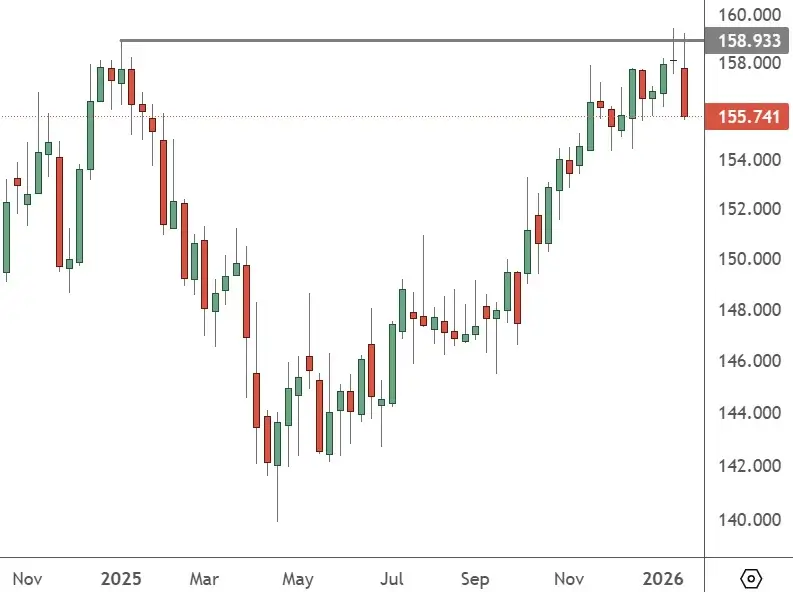
USDJPY – Weekly Chart
The USD/JPY has hit resistance at the January 2025 high and sold off. The move could be pivotal if it proves to be a medium-term high for the pair.
The BOJ released its latest monetary policy ideas on Friday and decided to hold interest rates steady amid recent bond market moves and market turmoil. The challenge now facing the bank is to balance rate hikes to support the yen without slower growth.
ING now expects another rate hike in June, while Prime Minister Sanae Takaichi dissolved the lower house for a February 8 election, adding political uncertainty. Japanese bonds have been hitting record highs on the long end due to fears over the PM’s spending plans.
“Although both Takaichi and the opposition argue that the proposed tax cuts won’t be financed by debt issuance, the specific financing method remains unclear. One possibility is that, as the BoJ begins to sell its ETF holdings this year,” ING analysts said.
On the economic front, Japan has been boosted by rising exports and core machinery orders, as the economy recovered from a contraction. “We believe that finalising the US trade deal and robust global semiconductor demand mainly drove the sharp increase in Japanese exports,” said analysts at ING.
However, USD/JPY could be volatile this month as Japan prepares for a snap election.
“It is hard to have a conviction call on USD/JPY right now. The playbook assumes that any big improvement in the LDP’s fortunes is a yen-negative on the view that looser fiscal and monetary policy will be favoured and more likely”.
The market is aware that Japan’s government is favouring a loose monetary policy amid surging long-term rates on government debt.
The 40-year yield vaulted above 4% to a fresh high, which is the highest rate for any maturity of the country’s debt in more than three decades. The jump in 30 and 40-year yields of more than 25 basis points was the most since Donald Trump’s tariffs were first announced.
“There is no clear funding source for the consumption tax cut, and markets expect it to be financed through government bond issuance,” said Yuuki Fukumoto at NLI Research. “The bond market is effectively the canary in the coal mine,” Fukumoto said, adding that “it’s hard to see a scenario where buying bonds makes sense”.
Traders should look to the recent rejection of the USD as a possible correction beginning.