

Key Takeaways
|
The Japanese yen has weakened against the US dollar as the gap between US and Japanese interest rates continues to favour the dollar. However, expectations of further rate hike in Japan and the risk of currency intervention could complicate the outlook for USD/JPY.
On 15 October, Bank of Japan (BOJ) board member Junko Koeda called for caution against delaying further rate increases, pointing to upside risks to inflation. Her comments have brought the BOJ’s next policy moves back into focus, although it remains unclear when rates might rise again.
Interest Rates and Treasury Yields
The gap between US and Japanese interest rates has been a key factor behind the yen’s weakness against the dollar.
- US Asset Advantage: US assets, including Treasury securities, offer relatively higher returns, making the dollar more attractive to investors and helping keep USD/JPY elevated.
- Treasury Yields: If US Treasury yields fall, the dollar’s yield advantage could narrow. However, persistent US inflation may make the Federal Reserve reluctant to cut rates quickly, potentially keeping yields higher for longer.
Japan’s policy direction could also shift the balance. The BOJ raised its policy rate to 1.25% in September, while board member Junko Koeda’s October comments have renewed attention on the possibility of a further rate.
Governor Kazuo Ueda has emphasised the importance of keeping underlying inflation close to the 2% target, while the BOJ must also consider how higher borrowing costs affect households and businesses. If the BOJ continues to raise rates while US yields fall, the interest-rate gap could narrow, giving the yen room to recover. If Japanese policymakers move more cautiously while US yields remain elevated, the dollar could retain its advantage.
Carry Trades and Yen Demand
The yen has long been a popular funding currency for carry trades. Because Japanese interest rates have generally been lower than those in other major economies, investors can borrow yen at a relatively low cost and deploy the funds to invest in currencies or assets that offer higher returns.
When markets are calm and interest-rate gaps remain wide, these trades can add to selling pressure on the yen. However, these positions can unwind when market conditions change:
- Changing Rate Expectations: If US Treasury yields fall or the BOJ signals further rate hikes, the return advantage of holding higher-yielding currencies could narrow.
- Rising Risk Aversion: When investors become less willing to take risks, they may close carry trades and buy back yen to repay their borrowings, increasing demand for the currency.
If a large number of investors unwind their positions simultaneously, the yen could strengthen rapidly, putting downward pressure on USD/JPY. The magnitude of the move would depend on the extent of the unwinding and on whether the underlying changes in monetary policy and market sentiment persist.
Why Is the 160 Level Important?
The 160 level has become a closely watched threshold for USD/JPY, partly due to Japan’s previous interventions during periods of sharp yen weakness. A weaker yen also increases import costs for energy and goods, putting pressure on Japanese households and businesses.
In late July 2026, USD/JPY climbed towards 164 before falling by more than 3% on 30 July to around 158 amid suspected intervention. Subsequent reports described coordinated intervention by Japanese and US authorities.
As USD/JPY approaches 160, traders will be watching official comments and technical indicators, including the 200-day Simple Moving Average (SMA). As shown in the daily chart below, the 160 level serves as a reference point for monitoring price movements, while the 200-day SMA provides a broader view of the pair’s trend. However, 160 is not an official intervention trigger, and neither level guarantees the pair’s next direction.
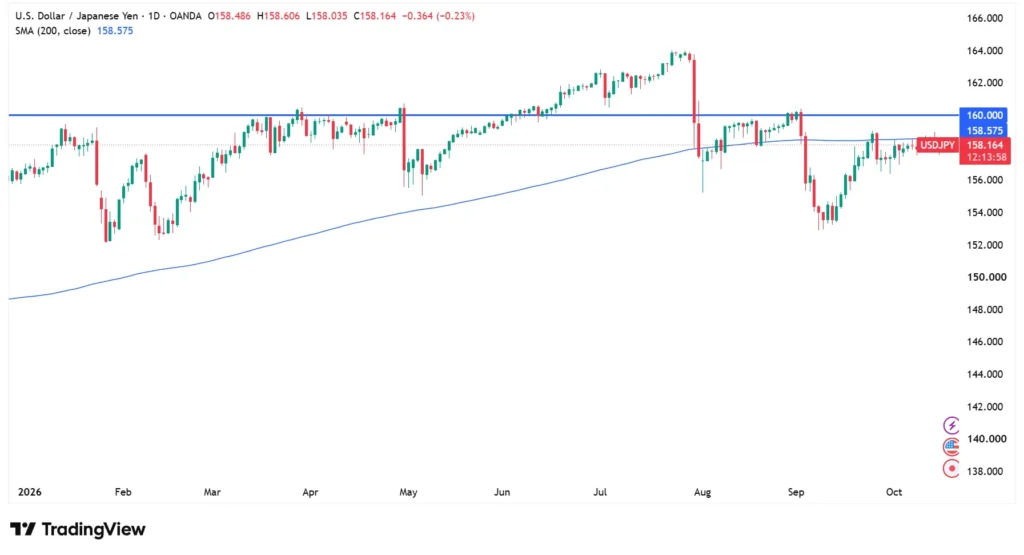 Figure: USD/JPY daily chart for 2026, showing the 160.000 level, the 200-day Simple Moving Average (SMA) and recent price consolidation. Source: TradingView
Two Possible Directions for USD/JPY
USD/JPY could move in either direction as markets reassess US and Japanese monetary policy. Two scenarios are worth watching:
| Scenario | What could drive the move? |
| Scenario 1: USD/JPY Falls (Yen Strengthens) | A Narrower Interest-Rate Gap: If the BOJ raises rates while US Treasury yields fall, the dollar’s advantage over the yen could narrow. Carry Trades Unwind: If investors become more cautious, they may unwind carry trades and buy back yen, increasing demand for the currency. Intervention by Japan: Further warnings or action from Japanese authorities could put pressure on USD/JPY. |
| Scenario 2: USD/JPY Stays High (Dollar Remains Supported) | US Rates Remain High: If inflation remains persistent, the Fed may be slow to cut rates, supporting the dollar. The BOJ Takes Its Time: If the BOJ holds off further rate increases, the gap between US and Japanese interest rates could remain wide, limiting the yen’s recovery. |
Neither scenario is certain. Economic data, central-bank guidance and shifts in market positioning could alter the outlook.
Managing Risk and Watching Related Markets
Central-bank decisions, economic releases and intervention headlines can all trigger sharp movements in USD/JPY. Traders should consider position sizes, use stop-loss orders where appropriate and keep track of major economic announcements.
Stop-loss orders can help define risk, although execution prices may differ from requested levels in fast-moving markets or during price gaps. Traders should also review their positions when new data or policy guidance changes the rationale for them. No single approach can eliminate trading risk.
Other markets can provide useful context for the yen’s direction:
- EUR/JPY, GBP/JPY and AUD/JPY: These pairs can help show whether yen strength or weakness is broad-based, although each is also influenced by developments affecting the other currency.
- US Treasury yields and Japanese government bond yields: Changes in the yield gap can help explain shifts in the relative returns available from US and Japanese assets.
Watching these markets alongside USD/JPY can provide a broader view of the forces affecting the yen.
Helping Traders Navigate USD/JPY
USD/JPY remains sensitive to the interest-rate differential between the US and Japan, shifts in bond yields and expectations for central-bank policy. While the dollar’s yield advantage could continue to support the pair, further BOJ rate increases, changes in carry-trade positioning or currency intervention could prompt a recovery in the yen. Monitoring economic data, policy signals and market movements can help traders assess how these competing factors may influence the pair’s direction.
ATFX provides access to market news and analysis to track developments across major asset classes, alongside Trading Central tools to support technical analysis and an economic calendar for tracking key economic releases and central-bank events. Traders can also explore the latest edition of ATFX Trader Magazine for further insights into the macroeconomic developments and market trends that shape currency movements. AT DeepSight is also available as an AI-powered market intelligence tool for analysing market patterns, news sentiment and macroeconomic events.