


Gold prices dropped below $4,350 an ounce on Tuesday as rising US Treasury yields and renewed expectations of tighter Federal Reserve policy reduced demand for non-yielding bullion. Spot gold fell more than 1% after a sharp rise in US yields strengthened the dollar and pressured precious metals.
Market Snapshot
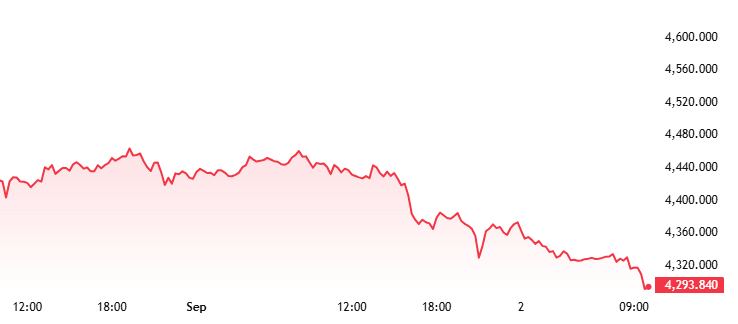
Spot gold (XAU/USD) fell to around $4,330 an ounce during US trading, extending losses after failing to sustain last week’s record-setting advance. The decline followed a period of strong gains that had pushed bullion above $4,500 as investors sought protection against inflation risks, geopolitical uncertainty and concerns over government debt.
US gold futures also moved lower, while other precious metals weakened. Silver declined alongside gold, while platinum and palladium also faced selling pressure as investors reduced exposure to commodities.
The US Dollar Index strengthened as Treasury yields climbed, making gold more expensive for international buyers. The move reflected a broad adjustment in expectations for the timing and pace of future Federal Reserve rate changes.
Rising Yields Pressure Bullion
The main driver behind gold’s decline was a sharp increase in US bond yields.
The benchmark 10-year Treasury yield moved higher as investors reassessed inflation risks and the possibility that the Federal Reserve may keep interest rates elevated for longer. Higher yields increase the opportunity cost of holding gold, which does not provide interest income.
The move followed recent economic data that showed continued strength in parts of the US economy. Although inflation has moderated from its peak, policymakers remain cautious about cutting rates too quickly while price pressures remain above the Fed’s 2% target.
Analysts said the latest pullback reflected a correction after gold’s rapid rally rather than a change in the longer-term demand picture.
Ole Hansen, head of commodity strategy at Saxo Bank, said investors were taking profits after bullion’s strong advance, adding that higher yields had triggered a short-term reassessment of positions.
Fed Expectations Shift
Markets have reduced expectations for aggressive monetary easing after several Federal Reserve officials warned that inflation risks remain.
Fed policymakers have maintained that future decisions will depend on incoming economic data, particularly employment conditions and inflation trends. Recent comments have suggested that officials are unlikely to rush into significant rate cuts unless there is clearer evidence of weaker growth.
The US labour market remains a key focus. Stronger employment figures could reinforce expectations that rates stay higher for longer, supporting the dollar and Treasury yields.
However, signs of economic slowing could quickly reverse the move. Lower rates would reduce pressure on gold and potentially attract investors back into bullion.
Gold Rally Faces Profit-Taking
The latest decline came after gold reached a series of record highs in recent months.
Bullion had benefited from several factors, including central-bank purchases, concerns over fiscal deficits, geopolitical tensions and expectations that global monetary policy would eventually become less restrictive.
Investors have also increased exposure through exchange-traded funds, reversing previous periods of outflows. Strong demand from institutional investors has helped strengthen gold’s role as a portfolio hedge.
However, the speed of the rally created room for a technical correction. Prices had moved significantly above key long-term averages, encouraging some traders to lock in gains when yields began rising.
Geopolitical Risks Remain Supportive
Despite the decline, geopolitical risks continue to provide underlying support for gold.
Investors remain focused on developments in the Middle East, including tensions surrounding Iran and risks to energy supplies through the Strait of Hormuz. Any renewed escalation could increase demand for safe-haven assets.
Trade uncertainty and concerns over government debt levels also remain important factors. Rising fiscal pressures in major economies have encouraged some investors to diversify away from traditional currencies and bonds.
These factors could limit further downside if gold approaches key support levels.
Outlook
Traders will watch upcoming US economic data, particularly labour market indicators and inflation reports, for clues on the Federal Reserve’s next policy move.
The direction of Treasury yields and the US dollar will remain the biggest short-term drivers for gold prices. A further rise in yields could extend pressure on bullion, while weaker economic data or renewed geopolitical concerns could revive demand.
Investors will also monitor whether gold can hold above key technical support levels after its recent record-setting rally, with the next move likely depending on the balance between Fed policy expectations, dollar strength and safe-haven demand.