


The Canadian dollar weakened on Tuesday as investors awaited a last-minute trade agreement with Washington before new 50% US tariffs were due to take effect on 19 August. The loonie slipped 0.2% to C$1.3900 per US dollar, or 71.94 US cents, giving back part of a rally that had taken it to a two-month high a day earlier.
Market Snapshot
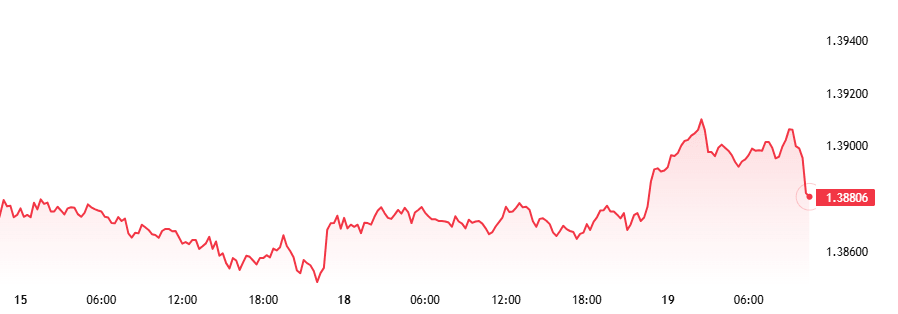
The Canadian dollar had strengthened as far as C$1.3842 on Monday, its highest level in more than two months, before trade uncertainty prompted some investors to reduce exposure. Canadian government bond yields also eased by two to three basis points across the curve on Tuesday.
The 30-year Canadian government bond yield nevertheless touched 4.173%, its highest since January 2010, reflecting broader pressure on long-term global borrowing costs. West Texas Intermediate crude rose 0.6% to $85.03 a barrel, providing some support for the commodity-linked Canadian currency.
Strategists at Monex Europe said a successful agreement could push USD/CAD towards C$1.37, while an escalation in the dispute could drive the pair back above C$1.40.
Tariff Deadline Approaches
Canadian Prime Minister Mark Carney spoke with US President Donald Trump on Tuesday afternoon, their second conversation of the week, as negotiators tried to avoid tariffs scheduled to begin at midnight. Officials provided little detail on whether the discussions had narrowed the remaining differences.
The new duties would apply a 50% tariff to about $20 billion of Canadian imports, including products from industries such as wine, furniture, dairy and lumber. The measures would apply even to qualifying goods under the United States-Mexico-Canada Agreement, removing protections that have shielded much of bilateral trade from earlier levies.
Canada’s Trade Minister Dominic LeBlanc and chief negotiator Janice Charette have been in Washington for talks with US Trade Representative Jamieson Greer and Commerce Secretary Howard Lutnick.
Auto Tariffs Remain Sticking Point
Vehicle trade has emerged as one of the main obstacles. Negotiators have discussed reducing existing US Section 232 tariffs on Canadian vehicles to 15% from 25%, with further deductions linked to the amount of US content in each vehicle.
Washington wants deductions to apply only to US-produced content, while Ottawa is seeking recognition of Canadian and Mexican components as part of integrated North American supply chains. About half the value of a Canadian-built vehicle can originate in the United States, illustrating the industry’s deep cross-border integration.
Canadian Chamber of Commerce chief executive Candace Laing said businesses had been performing a “high-wire act” as prolonged uncertainty delayed hiring and investment decisions. Industry groups have warned that additional tariffs could threaten jobs and business activity in particularly exposed sectors.
Inflation Offers Loonie Support
Domestic economic conditions have recently provided more support for the Canadian dollar. Canada’s annual inflation rate accelerated to 3.0% in July from 2.8% in June, slightly above expectations of 2.9%, as gasoline prices rebounded.
Underlying inflation remained more contained. The Bank of Canada’s CPI-trim measure stood at 1.9%, while CPI-median was 2.0%, close to the central bank’s target. The Bank of Canada has kept its policy rate at 2.25% since October 2025 and is scheduled to announce its next decision on 2 September.
The combination of improving Canadian economic data and relatively contained core inflation helped the loonie reach its recent highs, but the tariff threat has introduced a new risk to growth and monetary policy expectations.
Broader Trade Stakes
The dispute extends beyond the goods facing Wednesday’s duties. A failure to reach an agreement could complicate negotiations over the future of the USMCA, which underpins trade across Canada, the United States and Mexico.
New tariffs could also weigh on Canadian investment and exports, potentially offsetting some of the support the currency receives from higher oil prices and stronger domestic data.
Outlook
Currency traders will watch whether Ottawa and Washington announce an agreement before the tariff deadline, particularly any compromise on vehicle duties and rules for North American content.
The next drivers for the loonie will be the Bank of Canada’s 2 September decision and movements in oil prices. A trade agreement could support another move towards recent Canadian-dollar highs, while tariff implementation could renew pressure on USD/CAD above C$1.40.