



Oil prices jumped about 3% in early Asian trading on Monday as escalating attacks between the United States and Iran further disrupted energy shipments through the Strait of Hormuz. Brent crude moved above $90 a barrel for the first time in more than five weeks, extending a sharp rally from the previous week.
Market Snapshot
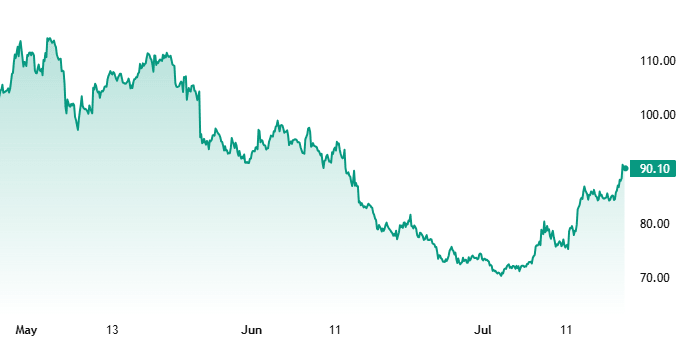
Brent crude futures (LCOc1) climbed $2.69, or 3.05%, to $90.79 a barrel by 2343 GMT, touching their highest level since 11 June. US West Texas Intermediate crude (CLc1) rose $2.19, or 2.65%, to $84.68, its strongest level since 12 June.
Brent gained 15.9% last week, its largest weekly rise since April, while WTI advanced 15.5%, its strongest weekly performance since early March. The gains reflected a growing risk premium as traders assessed whether Gulf exports could remain constrained for an extended period.
Conflict Escalates
The United States carried out a ninth consecutive night of attacks against Iran as the confrontation broadened across the region. Kuwait and Bahrain also reported fresh Iranian strikes, while the number of confirmed US military deaths from the renewed fighting rose to three.
Washington said its operations were intended to weaken Iranian military capabilities used to threaten commercial shipping. Iran, meanwhile, said it was targeting vessels that failed to comply with its navigation rules in the Strait of Hormuz. The United States has also begun enforcing a naval blockade around Iranian ports.
The latest escalation followed the breakdown of recent ceasefire efforts. It raised the prospect of a wider regional conflict involving Gulf energy infrastructure, military bases and maritime routes beyond Iranian territory.
Hormuz Traffic Falls
Shipping activity through the strait remained severely restricted. Four vessels completed the passage on Sunday, down from eight a day earlier, according to LSEG data. At least three product tankers and one very large crude carrier had entered the waterway since Friday to collect cargoes.
A vessel was also reported on fire northwest of Kumzar in Oman, according to the United Kingdom Maritime Trade Operations agency. Details about the vessel and the cause of the incident were not immediately available.
The Strait of Hormuz normally carries around 20 million barrels of oil per day, equal to about one-fifth of global petroleum consumption. It also handles roughly one-fifth of international liquefied natural gas trade, primarily from Qatar.
Supply Buffers Tighten
Amarpreet Singh, an oil analyst at Barclays, said the coming days would provide “a clearer picture” of how much regional oil could be exported under the competing shipping restrictions. He said markets appeared too relaxed about the potential effect on inventories, which were already near their lowest levels in five years.
The International Energy Agency said observed global oil inventories had declined at an average rate of 3.8 million barrels per day since the Gulf conflict began. Government-controlled stocks among developed economies had fallen to their lowest level since December 1990 as countries accelerated emergency releases.
Saudi Arabia and the United Arab Emirates operate pipelines that bypass Hormuz, but the US Energy Information Administration estimates that only about 2.6 million barrels per day of additional capacity may be available. That is a fraction of the volume normally transported through the strait.
Inflation Risks Return
Higher crude prices have revived concerns that energy and transport costs could push inflation higher, despite softer recent US consumer-price data. Interest-rate markets were pricing a roughly 60% probability that the Federal Reserve would raise rates as early as September.
Shane Oliver, head of investment strategy at AMP, said a prolonged disruption could eventually require substantially higher prices to reduce demand. He added that such an outcome was not his central forecast, but remained a significant risk.
The rise in oil also presents challenges for energy-importing economies, particularly in Asia. China, India, Japan and South Korea collectively receive most of the crude moving east through Hormuz, leaving their currencies, trade balances and refiners exposed to sustained increases in prices and freight costs.
Outlook
Traders will watch daily tanker movements through the Strait of Hormuz, any further US or Iranian attacks on shipping and energy facilities, and whether governments announce additional releases from strategic oil reserves.
Diplomatic contacts will also remain important. A verified ceasefire or recovery in vessel traffic could remove part of the geopolitical premium, while a prolonged blockade could tighten inventories further and push oil, inflation expectations and global interest-rate forecasts higher.