

Oil Movement Overview
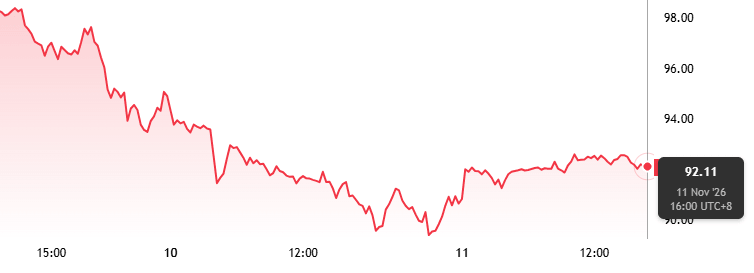
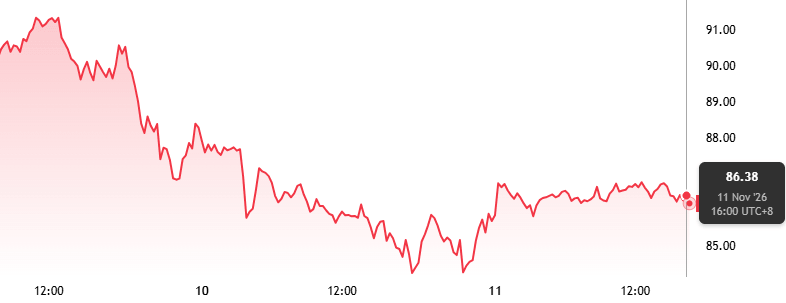
Oil prices edged higher in Asian trade on Wednesday after the previous session’s slide to their lowest levels since 31 August 2026, as US officials downplayed the need for further military action against Iran. As of 16:00 GMT+8 on 11 November 2026, Brent crude futures for January stood at $92.11 a barrel, while US West Texas Intermediate (WTI) crude futures traded at $86.38 a barrel.
Brent Crude Futures
US West Texas Intermediate (WTI) Crude Futures
Key Driver Behind The Move
US Secretary of State Marco Rubio said he told Group of Seven foreign ministers in Paris that US economic sanctions and a naval blockade were working, so President Donald Trump did not need to conduct major combat operations against Iran. Trump said on Monday that he planned to hold off on new strikes after appeals from regional countries, including Qatar’s prime minister during talks at the White House.
The market was continuing to prioritise Trump’s more conciliatory tone toward Iran since the US midterm elections. Early losses on Tuesday were trimmed after Iran’s top security official, Mohsen Rezaei, said no negotiations were currently taking place between Tehran and Washington.
Market Data And Reaction
The American Petroleum Institute said US crude inventories fell by 9.8 million barrels in the week ended 6 November 2026, a draw far larger than traders had expected. The figure often foreshadows the official government data, which is due later this week.
Both crude benchmarks remained in technically oversold territory at Tuesday’s close.
Broader Market Implications
Supply risks have not disappeared. Three tankers were seen catching fire in the Strait of Hormuz over the weekend, and the Saudi-led coalition in Yemen said it shot down missiles fired by Iran-backed Houthis at Saudi cities. Even so, other data showed oil and gas transits through Hormuz reached their highest level since the conflict began in February, and a survey showed OPEC output rose in October.
Policy expectations also bear on demand. October consumer price data from the Bureau of Labor Statistics came in stronger than expected, and market participants said this made a larger Federal Reserve rate rise in December more likely. Higher borrowing costs can slow economic growth and oil demand. Separately, Russian and Ukrainian officials met in Abu Dhabi for their first peace talks since February. The sides remain far apart, but any deal could allow Russia to export more crude.
What Oil Traders Should Watch
- US Energy Information Administration weekly petroleum status report, due at 01:00 GMT+8 on 13 November 2026, which can be compared with the API’s reported draw.
- International Energy Agency Oil Market Report, due at 17:00 GMT+8 on 13 November 2026.
- Meeting of the seven OPEC+ countries on 29 November 2026 to review market conditions.
- Ongoing US-Iran diplomacy, including Iran’s statement that no talks are under way, and shipping security in the Strait of Hormuz.