


Reviewing Gold’s Performance in 2026: A Dramatic Tale of “Extreme Contrasts”
The gold market in 2026 can only be described as “breathtaking.” In just four months, gold prices have experienced an entire cycle, from a meteoric rise to a deep correction.
Phase One: January – A Crazy Surge, History Rewritten
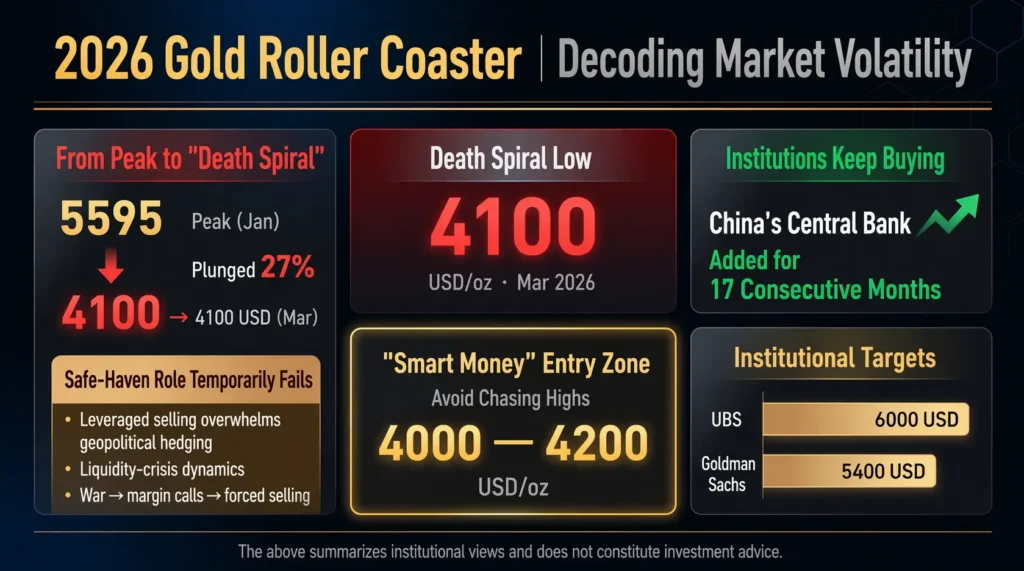
At the start of 2026, gold exhibited an astonishing breakout. The international spot gold price, starting near $4500/oz, surged to a historic peak of $5595.44/oz on January 29. Throughout January, the gold price saw a massive increase of 29.31%, continuing the 64% surge from 2025.
Phase Two: February to March – Avalanche-like Correction, Bullish Faith Tested
However, after reaching the peak, a steep fall followed. In February, as Middle Eastern geopolitical conflicts escalated, gold did not behave as expected, falling instead of rising. By the end of March, gold prices dropped below the $4318 level from late 2025, with a maximum loss of over 18%. At one point, prices even touched below $4100. This two-month crash resulted in massive losses for many investors who bought during the rally, and market sentiment swiftly shifted from extreme optimism to pessimism and confusion.
Phase Three: April to Present – Over-sold Rebound, Stabilizing Around $4800
Since April, as the market gradually absorbed the Federal Reserve’s hawkish stance and the situation in the Middle East showed subtle changes under ceasefire negotiations, gold entered a phase of rebound after overselling. By mid-to-late April, spot gold had stabilized above $4800/oz, hovering near $4830. Although part of the lost ground was regained, market sentiment shifted from the fervor at the beginning of the year to cautiousness, and gold prices have been fluctuating at high levels.
Who is Driving This “Roller Coaster”?
The extreme volatility in gold prices is not without reason. Behind it lies the intense battle between four key forces.
Federal Reserve Monetary Policy Expectations
The core driver of gold pricing revolves around “real interest rates.” The gold surge in January was mainly driven by the market’s expectation that the Federal Reserve would initiate 2-3 interest rate cuts in 2026, lowering real rates and reducing the opportunity cost of holding gold, thus drawing in funds. The February to March crash was triggered by the Fed’s March meeting, where they maintained high rates, slashing the expected rate cuts to just one, and even discussed the possibility of rate hikes. This reversal of expectations pushed up the U.S. dollar and Treasury yields, increasing the opportunity cost of holding gold, and leading to large-scale sell-offs.
Middle Eastern Geopolitics
The impact of the Middle Eastern situation on gold is not as simple as “war causes a rise.” The drop in February and March occurred during the peak of the Middle Eastern conflict. The logic is that war first drives up oil prices, which exacerbates market concerns about uncontrollable inflation. To curb inflation, the market expected the Fed to maintain tightening policies for a longer period, or even raise rates. This “tightening expectation” overshadowed the safe-haven demand, causing gold and oil prices to diverge unusually. Only when the war entered a stalemate and markets began to worry about long-term damage to economic growth (i.e., stagflation risk) did gold’s safe-haven appeal return.
U.S. Dollar Credit System and Central Bank Gold Purchases
The underlying logic of this gold bull market is the global “de-dollarization” trend. U.S. debt has surpassed $39 trillion, fiscal deficits are out of control, and Trump’s intervention in the Fed’s independence is continually eroding the dollar’s credibility. In response, central banks worldwide have initiated a rare gold-buying spree, with net gold purchases reaching 863 tons in 2025. This structural force provides strong long-term support for gold prices and is the main reason major institutions believe the bull market is far from over.
Market Liquidity and Speculative Sentiment
When liquidity is ample (as in late 2025 to early 2026), speculative funds flood in, pushing gold prices into overbought territory. But when liquidity tightens (as when the U.S. dollar surged in March), or during panic sell-offs, institutions sell gold ETFs indiscriminately to raise funds or lock in profits, exacerbating the volatility. These technical factors significantly amplify gold price fluctuations.
The “Trigger” of Gold’s Reversal
What caused the market reversal? Two clear signals marked the dramatic decline from $5600 to $4100:
Signal One: The Fed’s “hawkish surprise” in March. When the Fed explicitly stated that it was “not in a rush to cut rates” and might even “raise rates,” all previous expectations for easing collapsed instantly, sharply suppressing gold’s financial appeal.
Signal Two: The “transitional dominance” of the war-inflation logic. After the Middle Eastern conflict, the market first priced in not the safe-haven appeal, but the chain reaction of “war pushing up oil prices → oil pushing up inflation → inflation forcing the Fed to tighten.” In this scenario, gold suffered under the pressure of high interest rates, which are the opposite of inflation protection.
Is the Current Rebound Sustainable? Key Levels to Watch at $4800
The rebound from gold’s low point to above $4800 is driven by two main factors: first, expectations of renewed negotiations between the U.S. and Iran in Pakistan, leading to geopolitical easing; and second, the market gradually digesting the hawkish tone of the Fed’s upcoming hearings, beginning to re-price the “stagflation” risk.
Short-term Outlook: Before the ceasefire agreement expires on April 22 and the results of the Fed hearings become clear, the market will likely experience a choppy range-bound period. Gold is expected to continue oscillating or experience mild corrections, with $4800 acting as a key psychological and technical support. If this level holds and gold breaks through resistance between $4880 and $5000, the rebound could continue toward early March highs. Whether the rebound can sustain depends not on a single event but on the future direction of the four core forces.
Long-term Drivers for Gold’s Bull Market
Despite the short-term turbulence, the core logic driving gold’s long-term bull market remains intact and is even strengthening:
The Macro Story of “De-dollarization”: The U.S. debt crisis, weakening dollar credibility, and continuous central bank gold purchases provide gold with the most solid bottom support. Gold has surpassed the euro as the second-largest reserve asset, and its share in central bank reserves has exceeded U.S. Treasuries for the first time.
Stagflation as the Biggest Global Risk: High oil prices, high debt, and low growth co-exist. This “stagflation” environment is the most favorable macro context for gold. Economic stagnation suppresses real rates, while high inflation highlights gold’s value preservation function.
Fed Rate Cuts May Be Delayed, but Not Absent: The U.S.’s massive debt interest payments (over $1.2 trillion annually) will eventually force the Fed to ease. Once the rate-cut cycle begins, gold will enter a new wave of growth.
Global “Order Reconfiguration Premium”: The Israel-Palestine conflict and the Russia-Ukraine situation are not short-term risks but reflect the disintegration of the global unipolar order and the emergence of a multipolar world. This systemic uncertainty provides gold with a continuous “risk premium.”
Why Do Most Institutions Remain Bullish? What Is Their Core Logic?
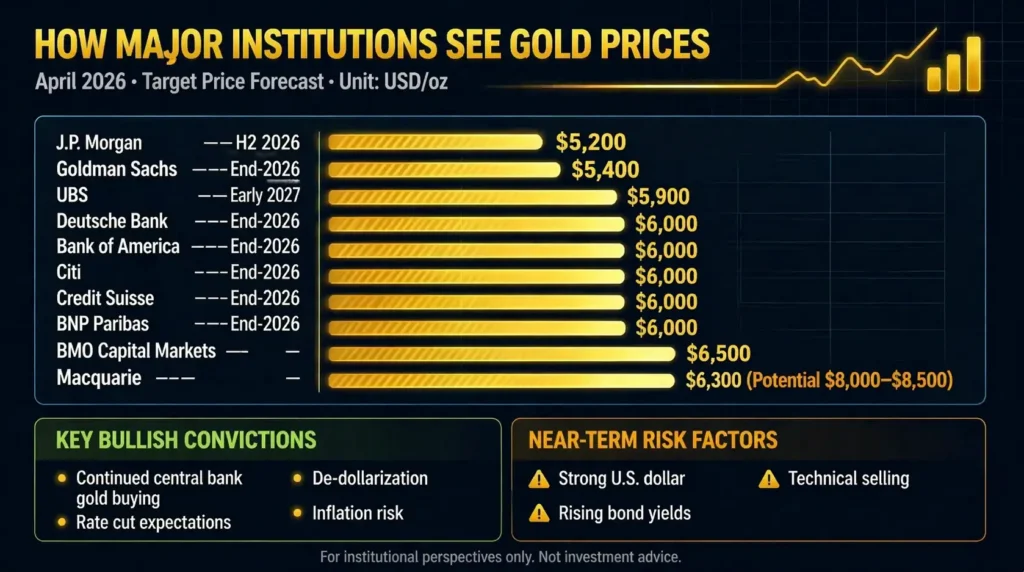
Mainstream institutions (Goldman Sachs, Wells Fargo, Morgan Stanley, etc.) are generally optimistic about gold’s long-term prospects, based on a rigorous logical framework. Some institutions believe the world is entering a fourth “currency devaluation cycle,” where debt and deficits weaken fiat currencies, making gold the top choice for wealth preservation. Mid-to-long-term bullishness is supported by structural forces: fiscal deficits, stagflation risk, and central bank gold purchases. Therefore, gold may face short-term pressure, but the long-term logic remains strong. Corrections are not the end of the bull market, but the starting point for further positioning.
How Can Ordinary Investors Position Themselves?
In the current “high volatility, strong logic” gold market, retail investors should avoid chasing rallies and selling in panic. Instead, they should develop a scientific allocation strategy. The core value of gold is to hedge risk, resist inflation, and diversify portfolio volatility, rather than seeking short-term profits. It should be viewed as the “keystone” of an investment portfolio. If seeking high returns, gold futures or leveraged products offer higher potential gains, but also come with risks. Gold ETFs, on the other hand, are more suitable for long-term holding.
The gold market in 2026 is undergoing significant short-term volatility due to the Fed’s policy and geopolitical struggles, but the long-term bull market driven by “de-dollarization” and “stagflation risk” remains intact. For retail investors, abandoning short-term market timing and sticking to a consistent investment strategy, controlling reasonable positions, and choosing convenient tools will be a viable way to protect and grow wealth in this historical transformation.
Special Note: The views, scenario analysis, and market evaluations presented in this article are for reference and exchange purposes only, and do not constitute any form of investment advice, trade recommendations, or endorsements of any financial products.