



The Australian Dollar (AUD/USD) slipped 0.3% to 0.7065 in early Asian trade on Tuesday as traders digested minutes from the Reserve Bank of Australia’s April meeting that reinforced a hawkish policy bias but stopped short of committing to an immediate rate hike. The pair pared gains from Monday’s rebound toward 0.7090, with selling pressure intensifying after the release showed policymakers remain divided on the timing of further tightening amid stagflation risks from elevated energy costs.
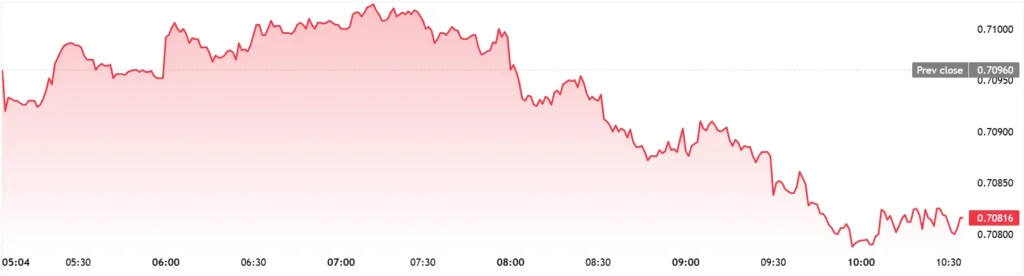
AUDUSD – 1 Day Chart
Market Snapshot
AUD/USD traded between 0.7055 and 0.7085 during the Sydney session, down from Monday’s close near 0.7089. The Aussie underperformed against a broadly firmer US Dollar, with the Dollar Index (DXY) holding above 104.50 on safe-haven demand linked to Middle East tensions. Cross-rates showed mixed performance, with AUD/JPY easing 0.4% to 107.20 as yen strength offset rate differential support.
Event Details
The RBA minutes, released at 11:30 a.m. Sydney time, revealed that while all board members agreed further tightening would likely be needed to return inflation to target, a 5–4 split vote in April highlighted growing caution over growth risks. Governor Michele Bullock’s reaffirmation that “inflation risks are tilted to the upside” due to persistent energy shocks kept the bias hawkish, but the central bank explicitly noted it cannot accurately predict the rate path given uncertainty over the Middle East conflict’s duration and scope.
Policy Response
Market pricing now implies a 65% probability of a 25 basis point hike at the May meeting, down from 75% before the minutes, with the cash rate futures curve pointing to a peak near 4.85% by year-end from the current 4.10%. “The minutes confirm the RBA is still hawkish, but the split vote and stagflation warnings make May far from a done deal,” said a Sydney-based FX strategist at a major bank, speaking on condition of anonymity.
Risk Flows
Australian 10-year government bond yields rose 3 basis points to 4.52% post-release, outperforming US Treasuries as traders positioned for sustained tightening bias. Equity markets shrugged off the currency weakness, with the S&P/ASX 200 (XJO) up 0.5% as energy and financials led gains, though miners lagged on China demand concerns.