


The price of Tesla (NAS100:TSLA) will be in focus this week as the EV giant releases Q4 earnings.
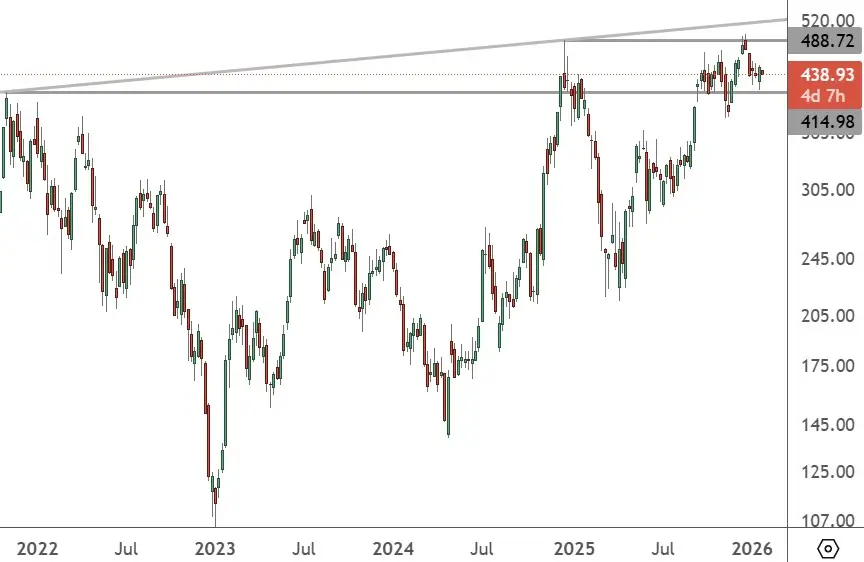
TSLA – Weekly Chart
The weekly chart of Tesla gives a better outlook for the path ahead. The share price is hovering in a range between $414.98 and $488.72. The $520 price level, which connects previous highs, could spark a new rally.
Tesla delivered a record quarterly performance in Q3, with 497,099 deliveries and revenue of $28.1 billion. That marked a 12% year-on-year growth for the EV maker. However, despite the strong delivery figures, there were underlying challenges, with 50,000 sales brought forward from Q4 as consumers rushed to secure the $7,500 US federal electric vehicle (EV) tax credit.
Operating margin was lower at 5.8%, as expenses surged 50% YoY to $3.4 billion, driven by increased spending on sales initiatives. Earnings per share declined by 31% YoY to $0.50, which was short of market expectations.
Outside of vehicles, the company’s energy storage segment performed well, posting a record 12.5 gigawatt-hours, an 81% YoY increase. The division registered $3.4 billion in revenue and $1.1 billion in gross profit, a much stronger profitability than the automotive division.
Tesla anticipates capital expenditures will rise in 2026 from approximately $9 billion in 2025, with much of that going to artificial intelligence infrastructure. Despite higher capex, the company still generated a record $4 billion in free cash flow for the quarter. Tesla now has total cash and investments of more than $41 billion, which will comfortably fund future ventures.
The Q4 earnings will have to deal with a sales slowdown, with 418,227 vehicle deliveries in Q4. That was a 15.6% decline from the prior year and below analysts’ expectations. China’s domestic competitor BYD surpassed Tesla as the world’s largest battery electric vehicle manufacturer in 2025, with 2.26 million units. Analysts are now projecting revenue of $24.78 billion, down 3.6% year over year.
The stock now trades near all-time highs, and the earnings call could be the factor that drives the share price higher or triggers a correction.