


Bitcoin fell below $60,000 on Tuesday as renewed US rate concerns and sustained withdrawals from spot exchange-traded funds pushed the largest cryptocurrency towards its first back-to-back quarterly loss since 2022. Bitcoin (BTC/USD) was down 2.9% at $58,628.70 by 18:00 ET, leaving it 14.1% lower for the second quarter.
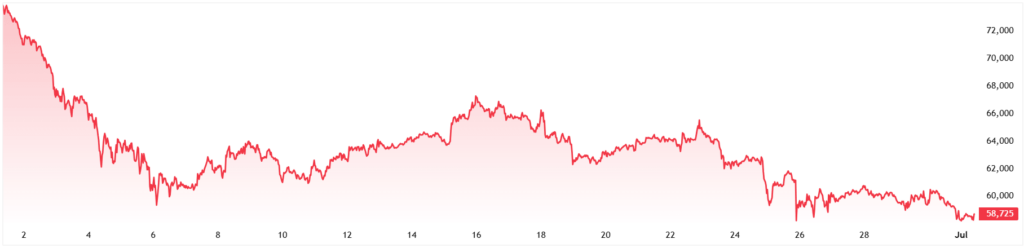
BTC/USD – 1 Month Chart
Market Snapshot
The decline kept Bitcoin near its weakest level of 2026, extending a selloff driven by tighter financial conditions, thin fresh inflows and caution across risk assets.
Ether (ETH/USD) fell 3% to $1,571.41 and was heading for a quarterly loss of more than 25%. XRP, BNB, Cardano and Solana also traded lower, while the global crypto market capitalisation hovered near $2.06 trillion.
ETF Flows And Rates
Spot Bitcoin ETFs recorded $231.1 million in outflows on Monday, according to SoSoValue data cited by Investing.com, taking June withdrawals to $4.3 billion. Outflows since the end of April stood near $6.7 billion.
The pressure followed a hawkish Federal Reserve meeting in June, which revived expectations that US rates could stay elevated or rise further. Higher yields tend to weigh on non-yielding assets such as cryptocurrencies by raising the appeal of cash and bonds.
Background Context
Bitcoin’s slide marks a reversal from the institutional demand that helped power earlier gains following the launch of US spot Bitcoin ETFs in 2024. Those funds made it easier for asset managers and retail investors to gain exposure, but the same channel can accelerate weakness when flows turn negative.
Confidence has also been tested by concern over corporate holders. Strategy, formerly MicroStrategy, disclosed in June that it sold 32 Bitcoin, its first sale since late 2022, though the amount was small relative to its holdings.
Policy Backdrop
Regulation remains another swing factor. The crypto industry is pushing for the CLARITY Act, which aims to establish broader US rules for digital assets, but progress has been slowed by political disputes and opposition from the banking sector.
Public Citizen said crypto firms had spent about $189 million to influence the 2026 US midterm elections, surpassing the previous cycle’s pace. The spending underscores how digital-asset policy has become a larger market and political issue.
Outlook
Traders will watch whether ETF outflows slow, whether US inflation and jobs data reinforce rate-hike expectations, and whether Bitcoin can reclaim $60,000 with sustained volume. They will also track US-Iran diplomacy and the next steps for crypto legislation in Washington.