


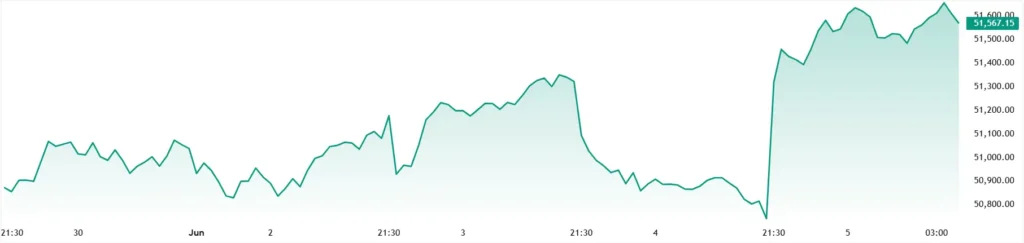
The Dow Jones Industrial Average surged to a record close on Wednesday, climbing 874.86 points, or 1.73 percent, to 51,561.93, as investors shifted capital away from semiconductor stocks and into health care and financial sector names.
The S&P 500 gained 30.63 points, or 0.41 percent, to 7,584.31, while the Nasdaq Composite slipped 23.02 points, or 0.09 percent, to 26,830.96, marking a sharply divided session on Wall Street.
The move came after Broadcom reported fiscal second-quarter revenue that fell short of analyst expectations, triggering a broad sell-off in chip stocks. Broadcom shares dropped more than 13 percent in after-hours trading after posting revenue of $22.19 billion versus the $22.27 billion estimated by analysts.
Health care led S&P 500 sectors with a 3.16 percent gain, followed by financials at 2.68 percent and real estate at 2.13 percent. Technology was the worst performer, declining 1.60 percent.
UnitedHealth Group rose nearly 6 percent after Bank of America upgraded the stock to Buy from Neutral, while Merck gained around 5 percent and Johnson & Johnson advanced more than 2 percent. Goldman Sachs and JPMorgan Chase each climbed more than 2 percent, and Caterpillar and Boeing added over 1.5 percent.
The PHLX Semiconductor Index, which has more than doubled since early 2023, faced pressure amid concerns that earnings growth may not keep pace with elevated valuations. Investors also cited potential regulatory headwinds, including tighter export controls on advanced chips to China and uncertainty around US CHIPS Act funding timelines.
Twenty-eight of the Dow’s 30 components closed higher, according to FactSet data, reflecting broad-based gains across the blue-chip index.
The rotation signals a potential broadening of the market rally beyond mega-cap technology stocks that have driven much of the 2026 advance. The Nasdaq has been powered by artificial intelligence–exposed equities, with chip names like Nvidia and AMD leading gains for much of the past 18 months.
Market strategists said the sustainability of the sector shift will depend on upcoming earnings reports and economic data. The Federal Reserve’s next policy meeting in late July will be closely watched for signals on interest rate policy, which could further influence rotation into rate-sensitive sectors such as financials and industrials.
This was the Dow’s 15th record closing high this year, underscoring continued investor confidence in the broader US economic outlook even as technology-heavy indices face valuation pressures.