


Seasonality, Monetary Policy, and Geopolitical Risk
As May begins, the US equity market enters a critical period, supported by strong technical momentum yet challenged by several macroeconomic risks. Seasonal factors, elevated inflation, high energy prices, and uncertainty over the US-Iran conflict are likely to remain key drivers of investor sentiment.
While the traditional market adage “Sell in May and go away” continues to attract attention, recent performance suggests a more balanced approach may be appropriate. Historical seasonality warrants caution, but stronger corporate earnings and resilient market momentum indicate that investors may still find selective opportunities in the months ahead.
Seasonality: A More Balanced View on “Sell in May”
| Period | Average S&P 500 Return (May – Oct) | Average S&P 500 Return (Nov – Apr) |
|---|---|---|
| Since 1945 (Long term) | 2% | ~7% |
| Last 10 Years | 7% | N/A |
| 2025 Performance | 22.1% | N/A |
Recent Monthly Averages (Last 10 Years)
Recent data suggests that selling in May would cause investors to miss substantial summer gains:
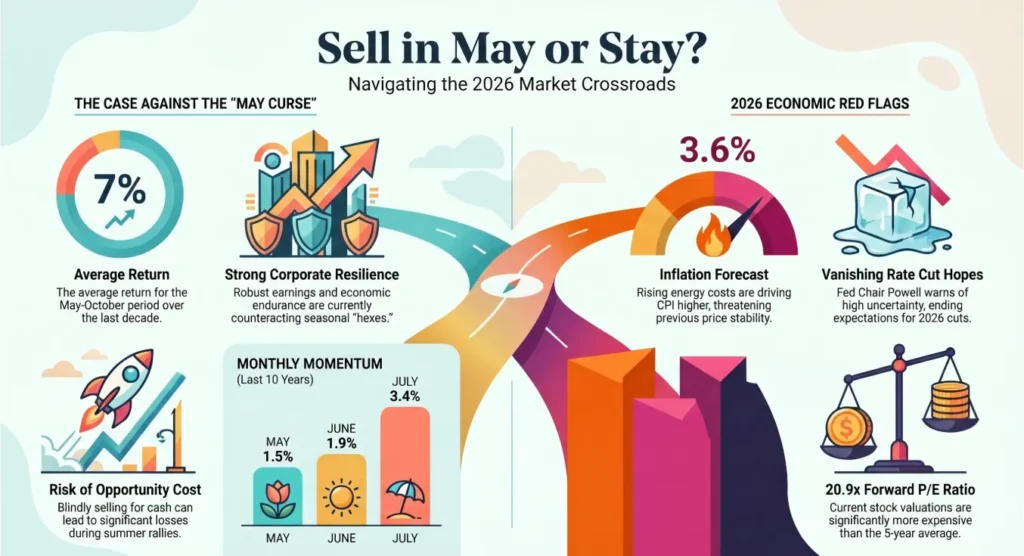
- May: 1.5% average return.
- June: 1.9% average return.
- July: 3.4% average return.
Historically, the May-to-October period has delivered lower returns for the S&P 500 than the November-to-April period. Since 1945, the S&P 500 has averaged about 2% from May to October, compared with around 7% from November to April.
However, recent data indicate that this seasonal pattern has become less reliable. Over the past decade, the May-to-October period has returned an average of about 7%, while 2025 recorded a strong 22.1% gain in the same period. Recent monthly averages also show positive performance, with May, June, and July posting average returns of 1.5%, 1.9%, and 3.4%, respectively.
This suggests that investors should avoid relying solely on seasonal trends and instead focus on macroeconomic conditions, earnings momentum, and policy expectations.
Geopolitical Risk Remains a Key Market Variable
Conflict remains a significant source of uncertainty. Oil prices remain above US$100 per barrel, which could put upward pressure on inflation and weigh on consumer spending if sustained. While markets have so far absorbed the shock, any further escalation could heighten volatility and reduce risk appetite.
Federal Reserve Policy: Rate Cut Expectations Continue to Fade
Monetary policy remains one of the most important drivers of market direction. Earlier in 2026, investors expected at least two Federal Reserve rate cuts. However, recent inflation data have weakened the case for policy easing.
US CPI rose to 3.3% in March 2026, marking a sharp increase and the strongest reading since April 2024. Forecasts also indicate that April CPI could rise further, potentially reaching 3.6%, driven by higher gasoline and manufacturing costs.
Federal Reserve Chairman Jerome Powell warned that the economic outlook remains “highly uncertain,” with the Middle East conflict adding further uncertainty. He also noted that higher energy prices could push overall inflation higher in the near term.
As a result, expectations for rate cuts in 2026 have become increasingly limited. JP Morgan Chase economists now expect the Federal Reserve to keep rates unchanged through 2026, with the possibility of rate hikes returning by the third quarter of 2027.
Valuation Risk: Markets Are Priced for Optimism
The S&P 500 is trading at a forward price-to-earnings ratio of 20.9x, above its five-year average of 19.9x. This suggests the market is already pricing in a relatively optimistic outlook.
If rate cuts fail to materialise, equity valuations may come under pressure. A higher-for-longer interest rate environment increases the discount rate applied to future earnings, which can reduce the present value of equities and lead to lower valuation multiples.
In this environment, investors may consider rotating towards more defensive or yield-sensitive assets, including US Treasury bonds, gold, and money market funds, particularly if the Federal Reserve maintains a restrictive policy stance.
S&P 500 Outlook: Uptrend Remains Intact, but Resistance Is Approaching
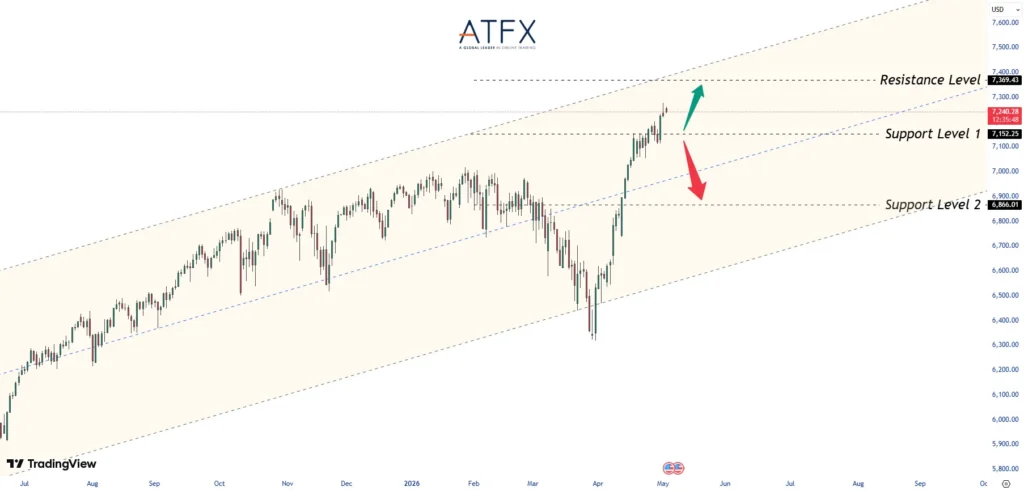
From a technical perspective, the S&P 500 remains within a broader rising channel. Following the March–April correction, the index staged a strong rebound, returning to the upper half of the channel. This suggests that market momentum remains constructive, with buyers still defending the broader trend.
The index is trading near 7,238 and approaching an important resistance zone. If the S&P 500 holds above 7,152, the near-term structure may remain supportive, allowing the index to retest the next resistance level around 7,369.
However, the index is now trading near the upper boundary of its rising channel so that upside momentum may face near-term resistance. If the S&P 500 fails to break above 7,369, the market could enter a period of high-level consolidation or experience a technical pullback. The first key support level to monitor is 7,152. A break below this level may weaken short-term momentum and expose the index to a deeper correction towards the 6,866-support region.
From a fundamental perspective, the S&P 500 continues to benefit from resilient corporate earnings and positive risk sentiment. However, elevated valuations, fading rate-cut expectations, high oil prices and geopolitical uncertainty may limit further upside. Therefore, the index should not be viewed negatively simply because of the “Sell in May” narrative, but investors should be cautious as the price approaches a key resistance zone.
Overall, the S&P 500’s short-term trend remains constructive as long as it holds above 7,152. A confirmed break above 7,369 could support further upside momentum, while a break below 7,152 would increase the risk of a deeper pullback towards 6,866.
Midterm Election Year: Additional Volatility Risk
The 2026 US congressional midterm election cycle may also contribute to market volatility. Historically, midterm election years have often been associated with less stable market conditions. In five of the last ten midterm election years, the S&P 500 declined between May and October, averaging about 1.5%.
While this does not imply that losses are inevitable, it underscores the need for disciplined risk management in the second and third quarters.
Key Risks to Monitor
Investors should closely monitor three key risks. First, sustained oil prices above US$100 per barrel could heighten inflationary pressures and weaken economic growth. Second, if the Federal Reserve confirms that rate cuts are unlikely in 2026, equity valuations may need to adjust. Third, any further escalation of the US-Iran conflict could disrupt global supply chains, push energy prices higher, and trigger a broader shift towards defensive assets.
Conclusion
A mix of seasonal caution, resilient earnings, persistent inflation, and geopolitical uncertainty shapes the May 2026 market outlook. Although the traditional “Sell in May” strategy remains relevant historically, recent market trends suggest that a more selective, data-driven approach may be more appropriate.
Equity markets continue to benefit from momentum and resilient corporate earnings, but the valuation backdrop leaves little room for disappointment. With rate cut expectations fading and geopolitical risks still elevated, investors should remain cautious, diversified, and prepared for higher volatility in the months ahead.