

Anthropic, the company behind Claude, has begun meeting with investors ahead of its proposed initial public offering (IPO). The company has applied to list on Nasdaq under the ticker ANT.
According to MSCI, the IPO price is expected to be set on November 18, 2026, with shares expected to begin trading the next day, November 19. Both dates are subject to change.
This guide breaks down what Anthropic does, where its IPO stands, and how to trade ANT shares.
What is Anthropic?
Anthropic is the AI company behind Claude, an assistant that helps people write, analyze documents, and build software. The company was founded in 2021. Co-founders Dario Amodei and Daniela Amodei serve as CEO and president, respectively.
Anthropic IPO at a Glance
| Variables | Position as of November 2026 |
|---|---|
| Company | Anthropic, PBC |
| Main product | Claude |
| Proposed exchange | Nasdaq Global Select Market |
| Proposed share symbol | ANT |
| Estimated IPO price | US70–78 per share |
| Expected first trading day | 19 November 2026 |
Anthropic IPO Timeline and Key Milestones
As of 15 November 2026, Anthropic has filed publicly and launched its roadshow. (A roadshow is the period when management and its banks present the offering to prospective investors.) The public announcement provides preliminary terms, while final pricing and the start of trading remain upcoming milestones.
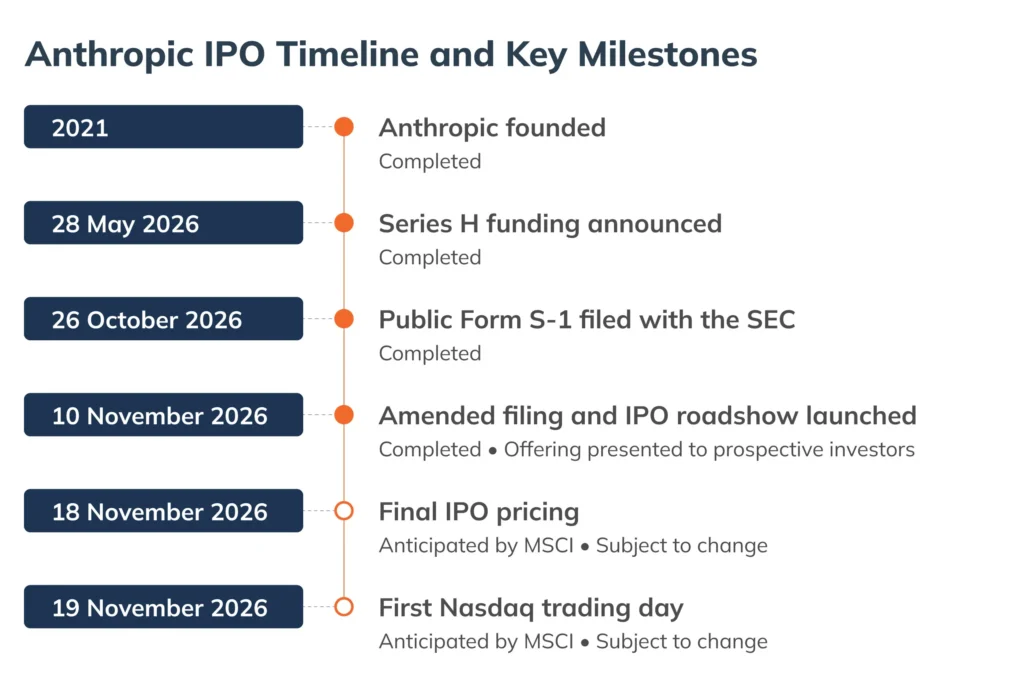
Image 1: Anthropic IPO Timeline and Key Milestones
What is Anthropic Stock (ANT)?
Anthropic stock (ANT) is the name & ticker symbol investors will see for the Class A common shares Anthropic plans to list on Nasdaq. Buying one of these shares would give you a small ownership stake in the company behind Claude and one vote per share on matters put to Class A shareholders.
The Nasdaq ticker ANT identifies the shares themselves. Brokers may use a different symbol for a related share CFD. For example, #ANT is ATFX’s symbol for its planned Anthropic share CFD, which lets you trade on the share price without owning the shares or gaining voting rights
How Does Anthropic Make Money?
Anthropic earns revenue through Claude subscriptions and usage fees. Individuals and teams pay for access to Claude, while developers pay to connect it to their applications. Enterprise customers may pay both seat fees and usage charges, allowing revenue to grow as more employees and applications use Claude.
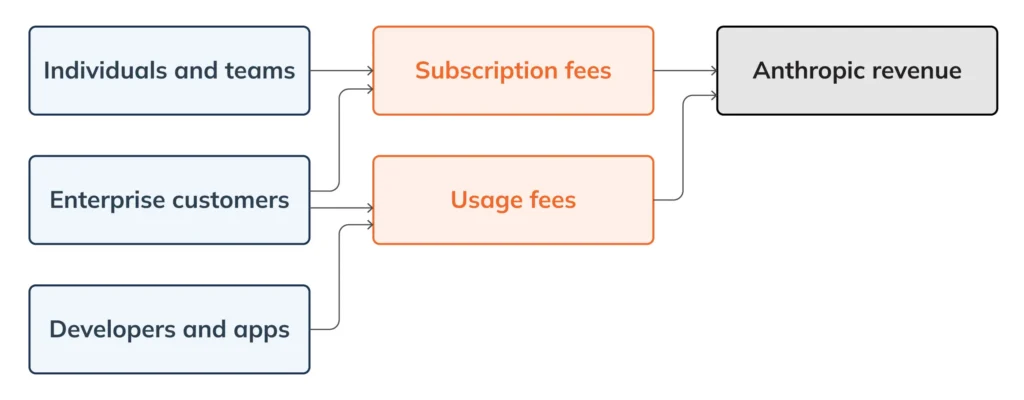
Image 2: Anthropic’s Source of Income
What Are Anthropic’s Main Costs?
Anthropic’s largest expense is computing infrastructure, which supports Claude’s development and customer usage. It also pays for employees, distribution partnerships, marketing and administration. In the first nine months of 2026, operating expenses reached $34.50 billion, with computing accounting for approximately 55%. These interim figures are unaudited.
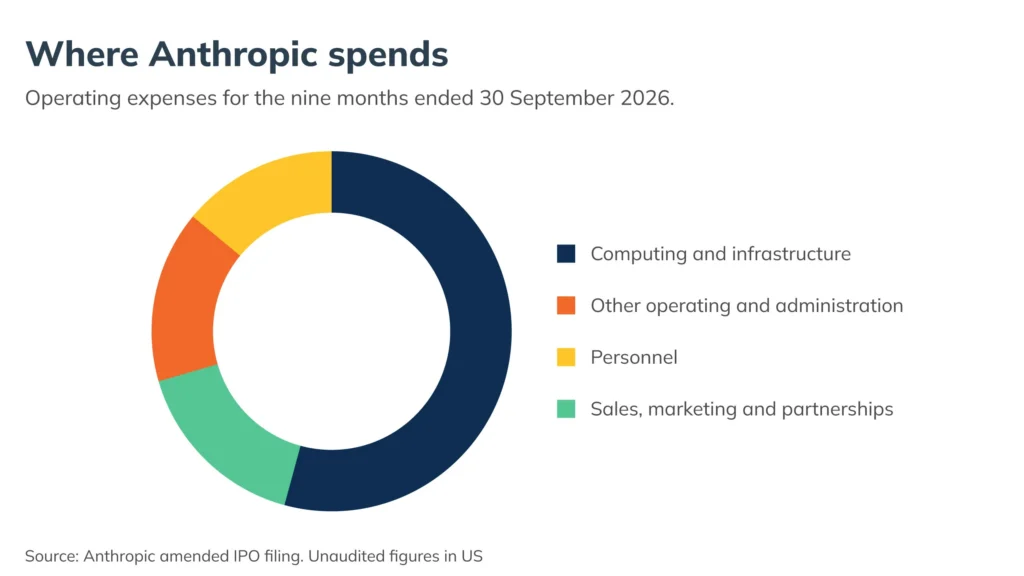
Image 3: Major expenses of Anthropic
What Is Anthropic’s IPO Price?
Anthropic announced an indicative IPO price range of USD70 – USD78 per share on 10 November 2026. The midpoint is USD74, while the final offer price remains subject to confirmation.
Once public trading begins, supply and demand will determine the market price, which may open above or below the IPO offer price. Traders should check the final pricing announcement and live platform quotes before placing an order.
How Many Shares Is Anthropic Offering and What Could It Be Worth?
Anthropic plans to offer 825 million shares to the public. At the top of its proposed price range,USD78 per share, the public offering would bring in a total USD64.35 billion. A separate USD26billion investment from strategic partners would bring the combined transaction amount to approximately USD90.4 billion, before fees and expenses.
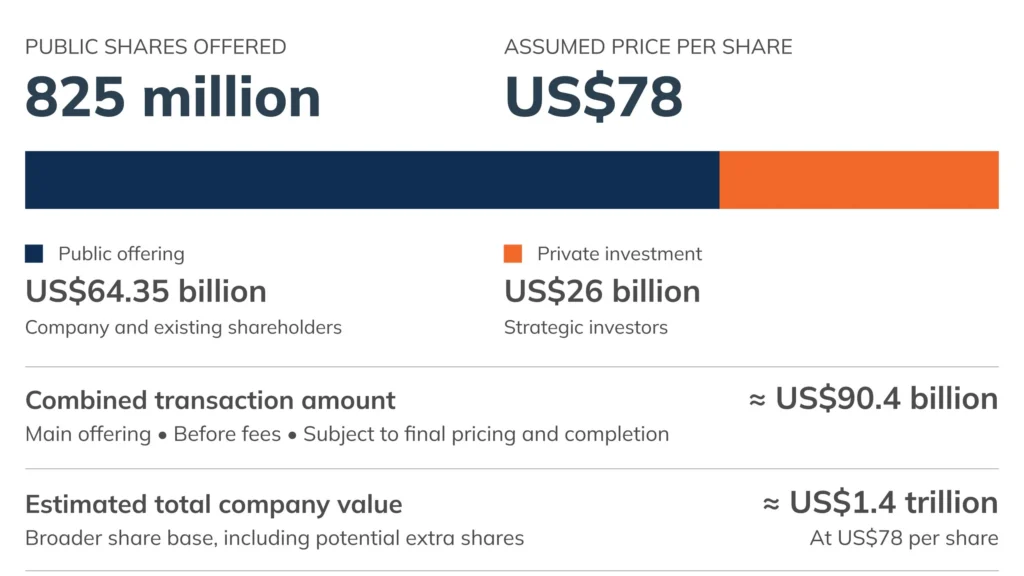
Image 4: Anthropic’s share ownership breakdown
At that price, Anthropic could have a total company valuation of approximately US$1.4 trillion, including potential extra shares from employee awards and other arrangements. The fundraising amount measures the value of shares sold in these transactions. The company valuation applies the share price to its broader share base. Final figures will depend on the IPO price and share-count assumptions.
Why traders should Trade on Anthropic stock’s IPO
Anthropic’s IPO would bring the company behind Claude into public markets, giving traders an opportunity to act on their views of its future. Before taking a position, consider how the following opportunities fit your trading strategy and the level of risk you can afford.
Opportunities From Price Movements
After an IPO, buyers and sellers decide, for the first time, what the shares are worth in the open market. As expectations change, the price may move sharply over a short period.
These movements can create opportunities for traders who correctly anticipate the direction. For example, buying shares and selling them later at a higher price produces a gain before costs. Selling at a lower price produces a loss.
Direct Exposure to the AI Theme
Buying Anthropic shares gives investors an ownership stake in the company behind Claude. Its performance provides a way to follow how demand for AI services translates into business growth.
Investors can monitor customer adoption, revenue and competition to assess the company’s prospects. Returns will also depend on the price paid and how the business performs against expectations.
React to Company Developments
Earnings reports, new Claude models and major partnerships give traders specific events to monitor. These announcements may change expectations about Anthropic’s future revenue, spending and profitability.
Traders can prepare by considering different outcomes and deciding how much money to risk. Positive news may support the share price, while disappointing results may put it under pressure.
Ways to trade Anthropic stock
The available route depends on whether you want to own shares, trade price movements or gain exposure through a fund.
| Route | What you hold | What to check |
|---|---|---|
| Private transaction before listing | Private shares or an interest in a vehicle | Eligibility, ownership, transfer restrictions and fees |
| IPO allocation | Shares allotted through a participating broker | Access, deadlines and allocation rules |
| Exchange purchase after listing | Publicly traded shares | Broker access, execution price and dealing costs |
| Share CFD | A contract linked to share price changes | Margin, financing costs, trade size and availability |
| ETF or index-linked product | Exposure defined by the product’s holdings or benchmark | Actual Anthropic exposure, weighting and fees |
Table: Understand ways to buy or trade Anthropic stock
How to buy Anthropic before the IPO
Before public trading begins, access may be possible through an eligible private transaction. Such arrangements can have substantial minimums, transfer restrictions and limited opportunities to sell. Verify whether the investment gives you shares directly or an interest in a separate vehicle.
Research the seller and the documents carefully. The SEC warns that pre-IPO promotions can involve misleading claims about ownership, fees and the timing of a future listing.
How to participate in the Anthropic IPO
IPO participation requires access through a broker or intermediary involved in the offer, subject to local availability and eligibility. Check the subscription deadline, funding rules and allocation process. Requesting shares does not guarantee an allocation.
If you receive no allocation, you may be able to buy through a stockbroker after exchange trading begins. The market price can differ substantially from the IPO offer price.
How to Trade Anthropic With Less Upfront Capital
Trading Anthropic’s shares can require a smaller upfront payment than buying the equivalent shares outright. You set aside a portion of the total position value as margin, while gaining exposure to the full amount.
For illustration, 1 lot represents 100 shares, priced at US$74 each.The total position value is US$7,400. With an assumed 10% margin requirement, you would set aside US$740 to open the position.
This approach is available through a share contract for difference, or CFD, which lets you trade price movements without owning the shares. You can choose Buy when expecting a rise or Sell when expecting a fall.
The following example compares buying 100 shares in full with trading one equivalent lot on margin. All amounts are in US dollars.
| Comparison | Buy shares in full | Buy with margin | Sell with margin |
|---|---|---|---|
| Trade quantity | 100 shares | 100 shares (1 Lot) | 100 shares (1 Lot) |
| Price per share (mid point) | $74 | $74 | $74 |
| Total position value | $7,400 | $7,400 | $7,400 |
| Cash paid or set aside upfront | $7,400 | $740 | $740 |
| Price rises 2% to $75.48 | $148 gain | $148 gain | $148 loss |
| ROI on upfront amount | +2% | +20% | −20% |
| Price falls 2% to $72.52 | $148 loss | $148 loss | $148 gain |
| ROI on upfront amount | −2% | −20% | +20% |
ROI = Profit or loss ÷ upfront payment or initial margin × 100%.
What Could Affect Anthropic’s Share Price?
Anthropic’s share price could rise or fall as investors reassess its growth, costs and future profitability. Four key factors to watch are customer demand, competition, computing costs and wider market conditions.
Customer adoption and spending on Claude
More customers and greater use of Claude could increase revenue and support investor confidence. Slower usage, cancellations or reduced customer budgets could weaken growth expectations.
Competition and product pricing
Better or cheaper competing products could attract customers away from Claude. Anthropic may need to improve its models or adjust prices, affecting both sales and profitability.
Computing Costs and Spending Commitments
Computing capacity helps Anthropic develop Claude and serve customers. However, large spending commitments could put pressure on cash flow if customer demand grows more slowly than expected.
Market conditions and borrowing costs
Interest rates, financing conditions and investor confidence in technology companies could influence the value investors place on Anthropic’s future growth.
The price reaction will depend on expectations. Even strong business results may disappoint investors if they had expected more.
Other Markets to Watch During the Anthropic IPO
Anthropic’s IPO could draw attention to companies that supply its computing power, distribute Claude or compete in AI. Watching these shares alongside major US indices can help traders distinguish company developments from wider market trends.
Nasdaq 100 and S&P 500
The Nasdaq 100 tracks 100 of the largest non-financial companies listed on Nasdaq, while the S&P 500 covers 500 leading US companies across multiple sectors. Together, they provide useful benchmarks for comparing technology shares with the wider market.
If Anthropic and related technology shares outperform the S&P 500, this may suggest stronger interest in AI. If both indices move together, broader factors such as interest rates, inflation or earnings may be influencing sentiment.
Historical comparison: Market performance around SpaceX’s IPO
SpaceX began trading under SPCX on 12 June 2026. The table below shows how the two indices performed around its debut.
| Period | Measurement dates | Nasdaq 100 | S&P 500 |
|---|---|---|---|
| First trading day | 12 June 2026 | +0.64% | +0.50% |
| First five trading sessions | 12–18 June 2026 | +3.26% | +1.44% |
| Approximately one month | 12 June–10 July 2026 | +1.29% | +2.45% |
These gains show what happened around SpaceX’s listing; they do not establish that its IPO caused the increases or predict how markets will react to Anthropic.
A listing also does not automatically guarantee index membership. Check confirmed constituents and weights before treating an index-linked product as providing direct Anthropic exposure. The Nasdaq 100 has separate eligibility rules, including a fast-entry process for qualifying large companies.
US Technology Shares Connected to Anthropic
Anthropic relies on cloud platforms and advanced chips to train and run Claude. Its partners provide a useful watchlist for following AI demand, infrastructure spending and competition.
| Company | Connection to Anthropic | What to monitor |
|---|---|---|
| Amazon | Primary cloud and training partner; distributes Claude through AWS | Claude usage, AWS demand and computing capacity |
| Alphabet | Provides Google Cloud services, TPU computing capacity and Claude distribution | Cloud growth, chip capacity and AI competition |
| Broadcom | Works with Google and Anthropic to expand TPU computing capacity | Deployment schedules and AI infrastructure demand |
| Microsoft | Provides Azure computing capacity and Claude access through Microsoft Foundry | Business adoption, Azure demand and infrastructure spending |
| NVIDIA | Provides GPU technology and collaborates on hardware and model optimisation | AI hardware demand and deployment progress |
Connections are based on Anthropic’s partnership announcements.
Stronger Claude demand could support expectations for its suppliers and distribution partners. However, infrastructure costs, competition and their other businesses also affect performance. These shares will not necessarily move in the same direction as Anthropic.
Analysis on Anthropic’s IPO
At US$74 per share, Anthropic would already carry substantial growth expectations. Using approximately 18 billion fully diluted shares, this implies a valuation of US$1.33 trillion, or roughly 16.4 times its US$81 billion October revenue run rate.
Anthropic’s quarterly revenue increased from US$11.56 billion in Q2 to US$16.96 billion in Q3 2026, approximately 47% growth. However, Q3’s reported operating margin remained −3%, compared with an adjusted margin of 15% that excludes certain expenses.
This supports a strong demand story, but sustained profitability remains a separate test. A higher share price would require investors to believe that customer spending can keep expanding while Anthropic improves its ability to turn revenue into profit.
Anthropic disclosed approximately US$70.7 billion of contractual commitments payable in the 12 months following September 2026. These are payment obligations, rather than a single year’s accounting expense.
The trading implication is that slower demand could have an outsized effect on expectations. Computing capacity supports expansion, but commitments still require funding if customer usage falls short. Strong revenue growth therefore needs to be assessed alongside spending and cash flow.
Valuation Scenarios Suggest Different Price Ranges
The following sensitivity analysis applies selected valuation multiples to the US$81 billion revenue run rate, assuming 18 billion fully diluted shares.
| Scenario | Valuation assumption | Implied share price | What would support this outcome? |
|---|---|---|---|
| Bear case | 11–13 times revenue run rate | US$50-US$59 | Slower customer spending, pressure on profitability or weaker demand for AI shares |
| Base case | 16–18 times revenue run rate | US$72-US$81 | Continued expansion with spending sufficiently controlled to support improving profitability |
| Bull case | 21–24 times revenue run rate | US$95-US$108 | Sustained rapid growth, stronger profitability and investors accepting a higher valuation multiple |
What These Prices Mean for an IPO Trade
Around US$72 – US$81, the shares would sit within this model’s base scenario. That leaves room for growth, but does not establish an obvious valuation discount.
Above US$90, the implied valuation exceeds 20 times the current revenue run rate. Buying at that level would depend more heavily on continued expansion or investors maintaining a premium valuation. A strong opening rally alone would not demonstrate that the higher price is justified.
Below US$60, the market would be applying a substantially lower multiple. This could improve the entry valuation, but traders would need to establish whether the decline reflects temporary selling or deteriorating business expectations.
These are valuation reference ranges, not established chart support or resistance levels. Once trading begins, combine them with actual price behaviour, execution costs and a predefined loss limit.
Read the full analysis: Anthropic Stock Valuation – Financial Results, Price Scenarios and Key Risks
Before entering, define your profit-taking level, loss limit and whether you intend to hold overnight. If the price moves beyond your planned entry or the setup becomes unclear, waiting for another opportunity is also a valid decision.
Explore Anthropic Trading with ATFX
Get ready to be among the first ATFX traders to trade ANT after its IPO. Prepare your live account ahead of launch, or explore the platform with a free demo.
Anthropic share CFD trading will begin once ATFX pricing is live, subject to regional availability.
Frequently Asked Questions
When Is Anthropic Going Public?
Anthropic is expected to begin trading on Nasdaq on 19 November 2026, with final IPO pricing anticipated on 18 November, according to MSCI. These dates remain subject to change.
What Is Anthropic’s Stock Symbol?
Anthropic has applied to list its shares on Nasdaq under ANT. ATFX’s planned Anthropic share CFD uses #ANT. Buying shares gives you ownership in the company; trading a CFD gives you exposure to price movements without owning shares.
What Is Anthropic’s IPO Price?
The proposed IPO price range is $70 – $78 per share. $74 is the midpoint, rather than a confirmed offer price. Once exchange trading begins, the market price may be higher or lower than the final IPO price.
How Can I Buy or Trade Anthropic Stock?
You may apply for IPO shares through a participating broker, subject to eligibility and allocation, or buy shares through a stockbroker after public trading begins. ATFX also offer Anthropic share CFD trading once its pricing is live, subject to regional availability.
How Much Would I Need to Trade Anthropic?
Eligible ATFX traders can access 1:10 leverage, equivalent to a 10% margin requirement. For example, trading 1 lot (100 shares) of Anthropic at US$74 per share would require US$740 in initial margin, compared with US$7,400 to purchase the shares in full.